
Best AI Writing Tools for Bloggers (2026): 8 Tools Worth Trying
Writing a blog sounds simple until you’re the person doing everything.
You need to come up with topics, research the subject, build an outline, write the article, edit it, optimize it for search, create a few images, add internal links, and finally hit Publish.
Do that every week and the writing part can start to feel less like the fun part of blogging and more like a second job.
That’s where AI writing tools can help.
The good ones don’t simply spit out 2,000 words and call the job finished. They can help you get past a blank page, organize research, improve awkward sentences, find content gaps, and speed up the repetitive parts of publishing.
But there is a catch.
More AI does not automatically mean better content.
A blog filled with generic AI articles can actually be harder to build than a smaller site with fewer, more useful posts. The best results usually come from using AI for speed while keeping the important decisions—what to write, what to say, what to verify, and what your readers actually need—in human hands.
Bloggers can use AI writing tools during the research and outlining stage to organize ideas before writing the first draft.
This guide looks at 8 AI writing tools for bloggers, including general AI assistants, dedicated writing platforms, SEO tools, and editing software.
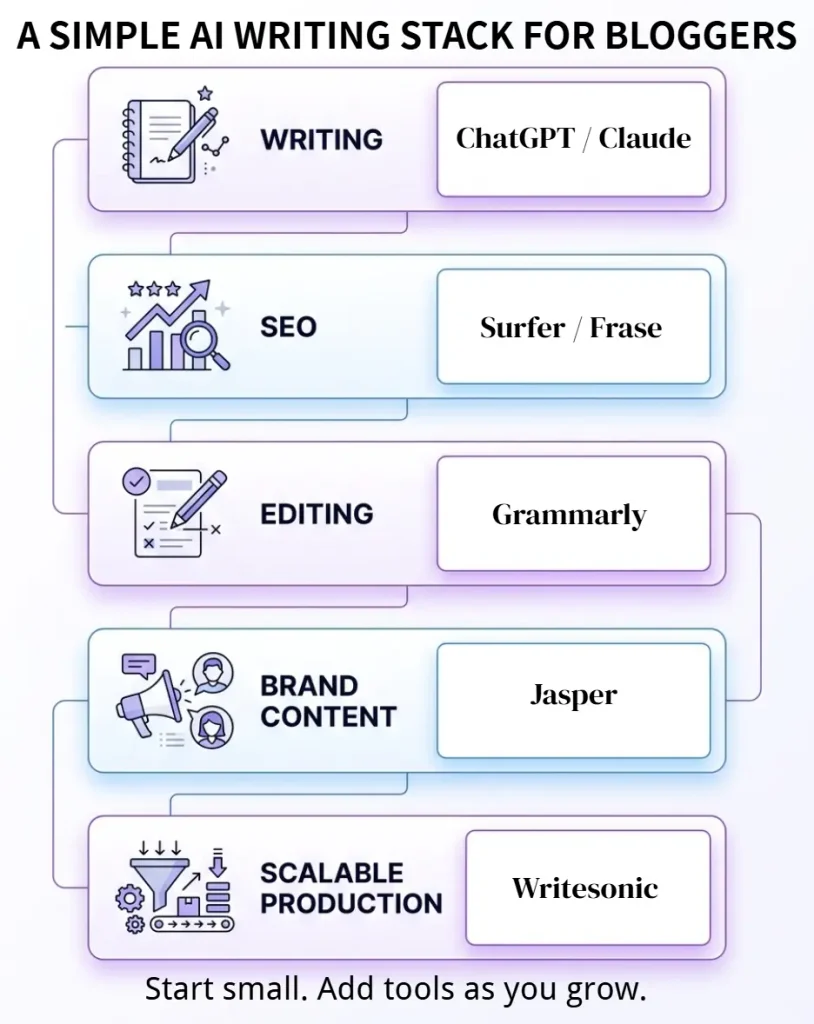
Quick answer: Most bloggers don’t need all eight. Best AI Writing Tools for Bloggers, A simple setup might be ChatGPT or Claude for drafting, Grammarly for editing, and Surfer or Frase when SEO research and optimization become a bigger part of your workflow.
Affiliate disclosure: Some links in this article may be affiliate links. If you purchase through one of those links, SoloBizStack may earn a commission at no extra cost to you. This does not affect how we describe or compare the tools.
How We Tested and Compared AI Writing Tools
We compared AI writing tools based on:
- Writing quality
- Ease of use
- Editing features
- SEO support
- Pricing
- Suitability for beginner bloggers
Best AI Writing Tools for Bloggers at a Glance
| Tool | Best For | Main Strength | Best Fit |
|---|---|---|---|
| ChatGPT | General blog writing | Brainstorming, outlining, research, drafting | Most bloggers |
| Claude | Long-form writing | Context, documents, editing, research | Detailed content |
| Jasper | Marketing content | Brand voice and marketing workflows | Affiliate/content businesses |
| Writesonic | SEO content | AI articles + SEO/GEO workflows | Search-focused blogs |
| Surfer | Content optimization | SEO analysis and content optimization | Bloggers targeting search |
| Frase | Content research | Research, briefs, SEO/GEO optimization | Solo content sites |
| Grammarly | Editing | Grammar, clarity, tone, rewriting | English-language bloggers |
| Copy.ai | Workflow-based content | AI workflows and GTM content | Teams and business workflows |
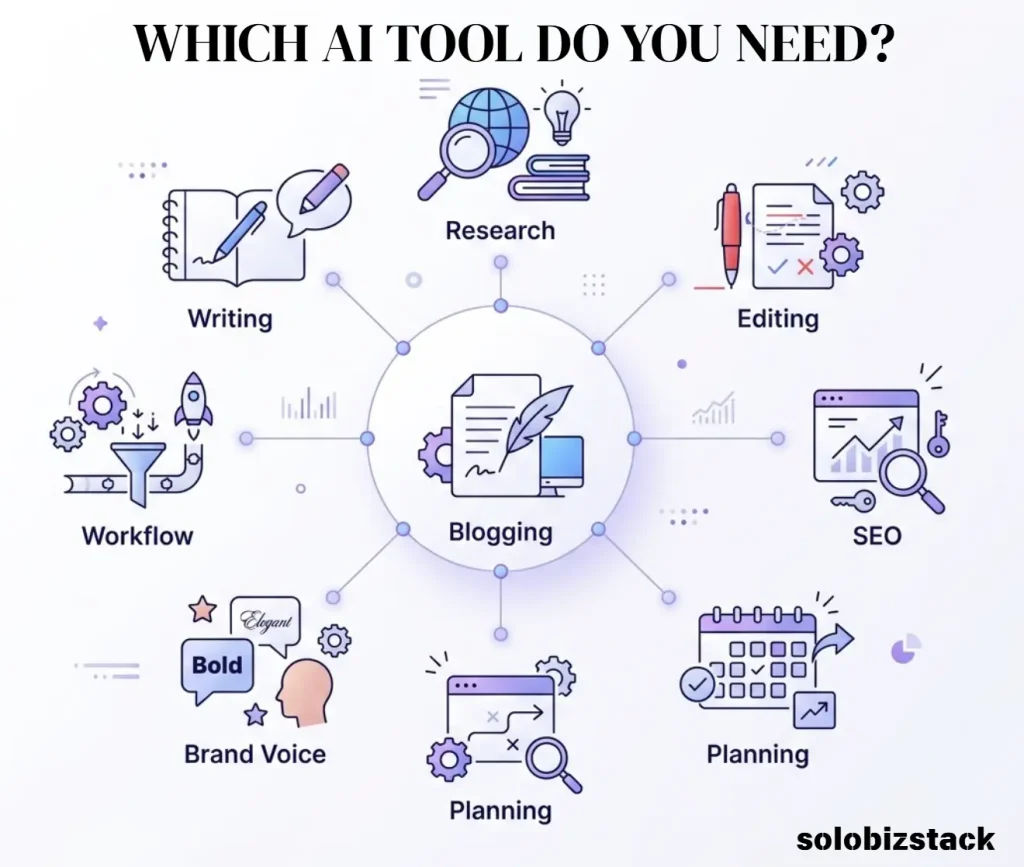
One thing to notice: these tools are not really competing for the exact same job.
Some are writing assistants. Some are SEO platforms. Some are editing tools. And some are better thought of as content workflow systems.
That distinction matters when you’re deciding what to pay for.
1. ChatGPT — Best All-Around Writing Assistant for Bloggers
For most bloggers, a general-purpose AI assistant is the easiest place to start.
ChatGPT can help with brainstorming, outlines, research, editing, content planning, summaries, and many other parts of the writing process. OpenAI currently describes ChatGPT’s research tools as useful for gathering information, comparing sources, identifying gaps, and producing structured, cited research. ChatGPT Plus currently costs $20/month, although features and usage limits can change over time.
The biggest advantage is flexibility.
You can use the same tool at several stages of a blog post:
Before writing:
“Give me 15 article ideas for beginners who are trying to start a WordPress website.”
During planning:
“Group these ideas by search intent and suggest which topics should link to each other.”
During writing:
“Turn this outline into a conversational first draft. Keep the examples practical.”
During editing:
“Find sections that sound repetitive or generic.”
That’s much more useful than treating AI as a one-click article generator.
For a new blogger, ChatGPT can also be useful for things that have nothing to do with writing. You can use it to work through content calendars, spreadsheet data, business ideas, site structure, or research notes.
Best for: Bloggers who want one flexible AI tool that can help across the entire content process.
2. Claude — Best for Long-Form Drafts and Detailed Editing
Claude is another general-purpose AI assistant, but it can be especially useful when you’re working with longer documents and need to keep a lot of context in one place.
Anthropic’s current Pro plan includes higher usage, Projects for organizing chats and documents, Research, integrations, and extended thinking. Anthropic currently lists Pro at $20/month when billed monthly, with a discounted annual option.
For bloggers, the Projects feature can be useful when you have ongoing content work.
For example, you could keep:
- Your target audience
- Your content guidelines
- Existing article outlines
- Brand voice notes
- Product information
- Research documents
in one project instead of copying the same context into every new conversation.
That can make a difference when you’re building a site with dozens of related articles.
Claude is also useful for editing longer pieces. Instead of asking for a rewrite of a single paragraph, you can give it the broader context and ask:
“Which sections feel repetitive, too generic, or disconnected from the reader’s actual problem?”
That’s closer to how a good editor works.
Best for: Long articles, detailed revisions, research-heavy content, and bloggers who want persistent project context.
3. Jasper — Best for Marketing-Focused Blog Content
Jasper is built with marketing teams and branded content in mind rather than being a general chatbot first.
Its current Pro plan includes a Canvas workspace, marketing agents, and brand customization features such as Brand Voices, Knowledge assets, and Audiences. Jasper currently lists Pro at $69/month when billed monthly or $59/month when billed annually.
That makes Jasper more interesting when you’re not just writing blog posts—you are building content around a brand.
For example, you might want your articles, landing pages, emails, and promotional copy to maintain a consistent voice.
That’s where features around brand context become more useful than simply getting another AI-generated paragraph.
For a tiny personal blog, Jasper may be more than you need.
For a growing content business where consistency matters across multiple content formats, its positioning makes more sense.
Best for: Bloggers who also write marketing content, landing pages, emails, or other brand-focused material.
4. Writesonic — Best for SEO-Focused AI Content
Writesonic is aimed at a broader content and search workflow rather than plain text generation.
Its current platform combines AI article creation with SEO and AI-search visibility features. Its Starter plan currently includes AI articles and site audits, while higher tiers add more content and AI visibility capabilities.
This makes it interesting for bloggers who think about content from the beginning as a search asset.
Instead of:
“Write me a blog post about WordPress hosting.”
the workflow becomes:
Research the topic → identify the search intent → create the article → check optimization → monitor visibility.
That can save time when you’re publishing regularly.
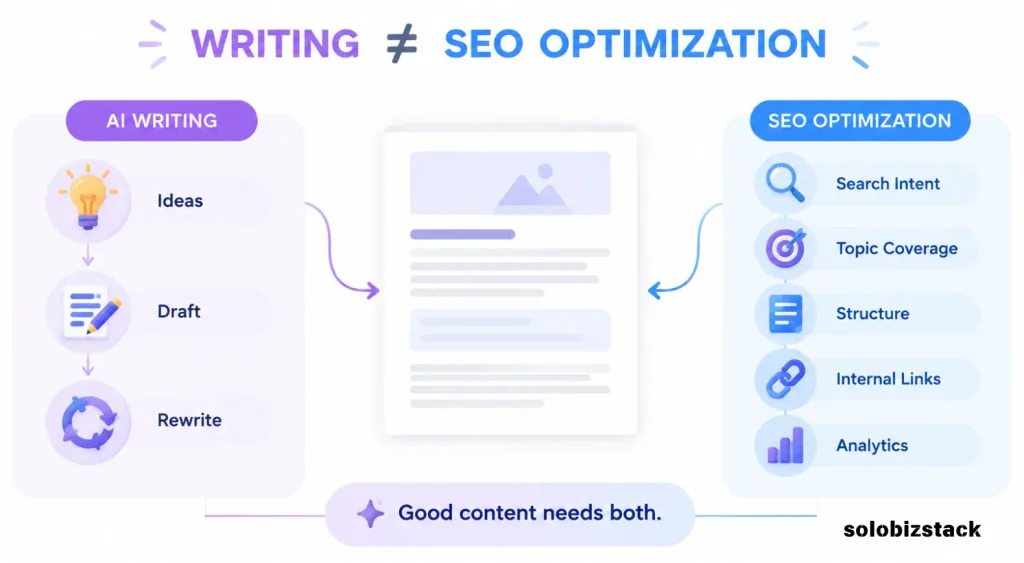
Still, there is a good reason not to blindly publish whatever an AI SEO platform generates.
Optimization tools are good at identifying patterns. They are not a substitute for actually understanding the reader.
Best for: Bloggers who want AI writing combined with SEO and AI-search visibility features.
5. Surfer — Best for Optimizing Blog Content for Search
Surfer is slightly different from the other tools on this list.
It is less about “write something for me” and more about helping you understand how an article can be improved for search.
Its current platform includes Content Editor, AI writing, content audits, keyword research, topical maps, and AI visibility features. The current Essential plan includes content optimization and a limited number of AI articles, while higher plans provide larger limits.
This is useful when you’ve already written an article and you’re wondering:
- Did I cover the topic thoroughly?
- Am I missing important subtopics?
- Is my structure reasonable?
- Are there obvious optimization opportunities?
- Are there related topics worth covering?
That makes Surfer particularly useful for an established blog where SEO is becoming a bigger part of the content strategy.
It can also be useful before writing. You can use the research and topic tools to shape the article before you spend hours drafting it.
Best for: Bloggers who already understand basic SEO and want help optimizing articles more systematically.
6. Frase — Best for Content Research and Briefs
Frase is another tool that sits somewhere between AI writing software and an SEO content platform.
Its current Starter plan is designed for solo users and single-site teams and includes article creation, page audits, SEO/GEO scoring, and AI visibility features. Higher plans add content calendars, internal-linking suggestions, and more advanced monitoring.
One of Frase’s useful ideas is that a good article starts before the writing begins.
Instead of opening a blank document, you can first build a content brief around:
- The main topic
- Search intent
- Related questions
- Supporting subtopics
- Competing content
- Internal links
That can be a better starting point for a blogger than simply asking an AI chatbot to “write a comprehensive article.”
The platform also supports publishing to WordPress and other content systems, which can be useful if your publishing process is already structured around a CMS.
Best for: Bloggers who care about research, content briefs, SEO structure, and a repeatable publishing workflow.
7. Grammarly — Best for Editing and Making AI-Assisted Writing Sound Natural
Getting an AI draft is easy.
Making it sound like something a real person would actually say is the harder part.
That’s where Grammarly can be useful.
Its current AI writing tools can help with rewriting, tone, brainstorming, and polishing text, while Grammarly Pro adds more advanced writing assistance. Grammarly currently lists a Pro subscription at $30/month, or $144/year.
For bloggers, Grammarly is especially useful as a final editing layer.
Instead of asking AI to write everything, you can write a rough draft, improve the ideas yourself, and then use Grammarly to clean up:
- Grammar mistakes
- Awkward sentences
- Repetition
- Tone
- Wordiness
- Unclear phrasing
That workflow tends to produce more natural content than publishing the first AI draft you receive.
Best for: English-language bloggers who want cleaner, clearer writing without making every sentence sound overly polished.
8. Copy.ai — A Workflow-Oriented Option for Content Teams
Copy.ai has evolved beyond the simple “AI copywriter” positioning many people remember.
Its current self-serve offering emphasizes chat, projects, workflow credits, and access to multiple AI models, while its higher-tier products are more focused on business and go-to-market workflows.
That makes it more relevant to businesses with repeatable marketing processes than to someone who just wants help writing a blog post once a week.
For example, you could use a workflow to move from:
Research → draft → repurpose → review → publish
rather than manually recreating the same instructions every time.
Best for: Structured content workflows and business teams that need repeatable processes.
Which AI Writing Tool Should a Blogger Start With?
Best AI Writing Tools for Bloggers, This is where I would avoid the usual “just buy the most powerful tool” advice.
Your best starting point depends on what is actually slowing you down.
You’re struggling to start writing
Try ChatGPT or Claude.
You probably don’t need a dedicated SEO writing platform yet.
You’re publishing SEO-focused content every week
Look at Writesonic, Surfer, or Frase.
These tools are more useful when research, optimization, and repeatable content production become part of your process.
Your biggest problem is English editing
Try Grammarly.
A good editing layer can be more useful than another article generator.
You’re building content around a brand
Consider Jasper.
Its brand-oriented features are more relevant when consistency across marketing content matters.
You want a repeatable content workflow
Look at Frase or Copy.ai, depending on whether your focus is content/SEO or broader business workflows.
What I Would Use for a New Blog
For a brand-new blog, I’d keep the stack small.
You don’t need eight subscriptions.
A practical starting setup could be:
Writing
ChatGPT or Claude
Use one as the main place for brainstorming, outlining, drafting, and content problem-solving.
Research and SEO
Frase or Surfer
You don’t necessarily need both at first.
Editing
Grammarly
Use it for the final pass rather than relying on AI to produce finished copy in one shot.
Design
Use a separate design tool such as Canva for blog graphics and Pinterest content.
That’s enough to publish consistently.
Once your workflow becomes predictable, then you can decide whether another tool would actually save time.
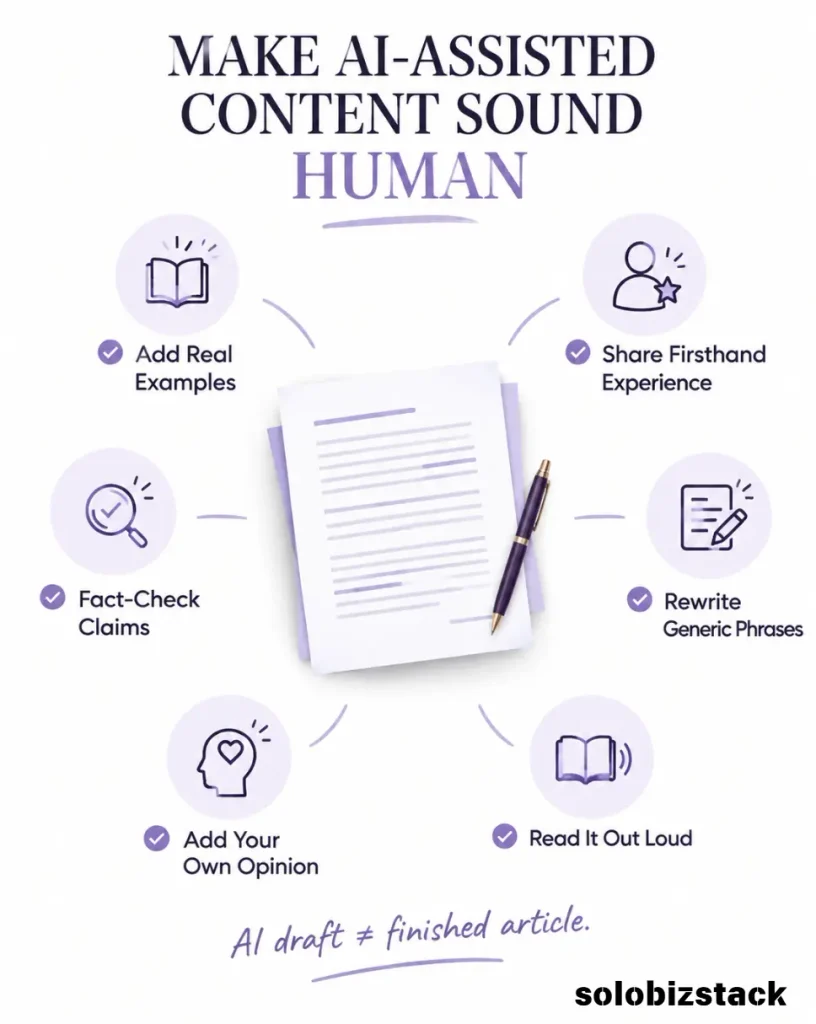
How to Use AI Without Making Your Blog Sound Like AI
This is probably the biggest issue with AI-assisted blogging right now.
A lot of AI-written articles sound similar because they follow the same pattern:
“In today’s fast-paced digital world…”
Then comes a neat introduction, five perfectly balanced headings, a bullet list, and a conclusion that says “In conclusion…”
There’s nothing wrong with structure.
The problem is when there’s no real voice behind it.
Here are a few things that help.
Start with your own examples
Don’t ask AI to invent a generic example if you already have a real one.
Tell it what actually happened.
Keep opinions where they belong
If you genuinely prefer one workflow, explain why.
Your reason is more useful than another paragraph of generic feature descriptions.
Add things AI couldn’t know
Screenshots. Actual tests. Your setup. Problems you ran into. Things that surprised you.
These are the details that make a blog useful.
Edit for rhythm
Read the article out loud.
If every paragraph has the same length and every sentence sounds perfectly polished, loosen it up.
Real people don’t write in exactly the same rhythm all the time.
Don’t publish the first draft
This is probably the simplest rule.
AI draft ≠ finished article.
Use AI to get moving. Then make the article yours.
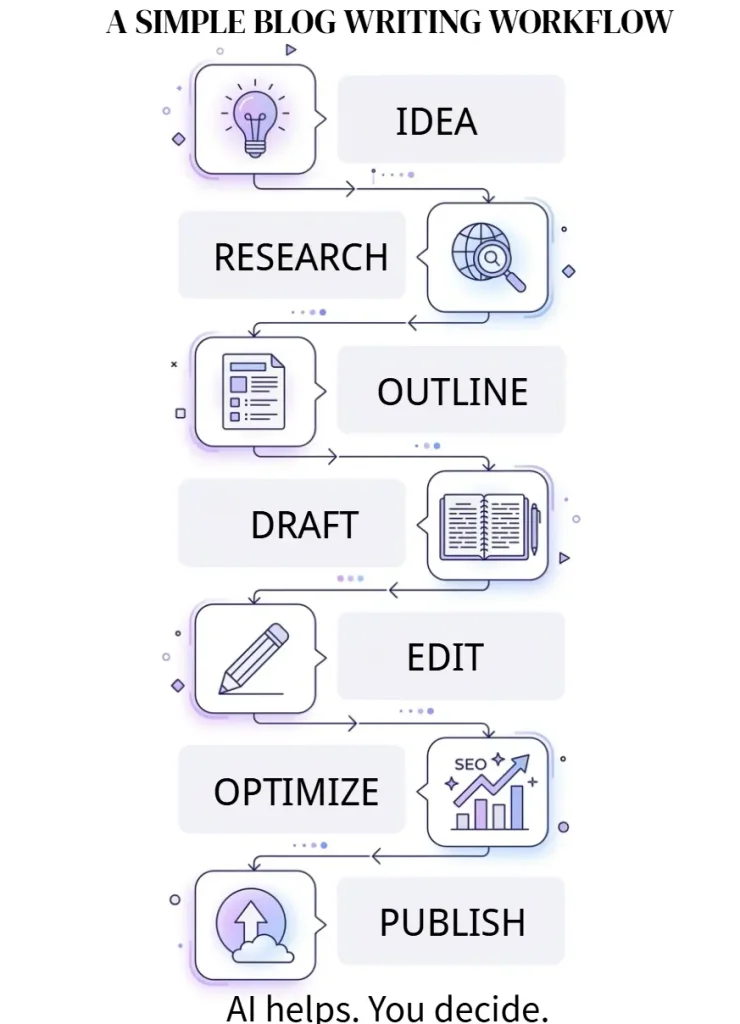
A Simple AI Writing Workflow for Bloggers
Here’s a practical workflow you can use for almost any article.
Step 1: Find the topic
Start with a real question your audience is asking.
Step 2: Research
Use search, official sources, competitor content, and AI research tools.
Step 3: Build the outline
Create the structure before writing the article.
Step 4: Draft
Use ChatGPT, Claude, Jasper, or another writing assistant to get a first draft moving.
Step 5: Add real information
Insert your own examples, screenshots, test results, opinions, and useful details.
Step 6: Optimize
Use Surfer or Frase when the article needs deeper SEO work.
Step 7: Edit
Run the finished draft through Grammarly, then read it yourself.
Step 8: Publish and improve
Watch Search Console, analytics, comments, and reader behavior.
The important thing is that AI sits inside the workflow.
It doesn’t own the workflow.
Are AI Writing Tools Worth Paying For?
Sometimes.
The answer depends on how often you publish and where the bottleneck is.
If you’re writing one article a month, a paid AI writing platform may be unnecessary.
If you’re publishing several useful articles every week, a good tool can save a meaningful amount of time.
Before paying for anything, ask three questions:
What part of my workflow is slow?
Does this tool actually solve that problem?
Will I still use it three months from now?
If you can’t answer the last question, start with a free plan or trial.
It’s surprisingly easy to collect AI subscriptions.
It’s much harder to actually use them.
AI Writing Tools vs. Human Writing
AI is very good at generating possibilities.
Humans are still responsible for deciding which possibilities are worth keeping.
That distinction matters for blogging.
A useful article isn’t valuable because it contains 2,000 words.
It’s valuable because the reader got something from it.
Maybe you explained something clearly.
Maybe you saved them an hour of research.
Maybe you tested a tool and showed exactly what happened.
Maybe you compared two options in a way that finally made the choice understandable.
AI can help you produce that kind of content faster.
It can’t replace the reason someone should trust your site.
Frequently Asked Questions
What is the best AI writing tool for bloggers?
There isn’t one tool that fits every blogger. ChatGPT and Claude are flexible general-purpose options, while tools such as Surfer and Frase are more focused on SEO and content optimization. Grammarly is useful when editing and clarity are the main concerns.
Can AI write blog posts?
Yes. AI writing tools can generate outlines, drafts, rewrites, summaries, and other content. But the first AI draft should usually be treated as a starting point rather than the finished article.
What is the best AI writing tool for SEO?
Tools such as Surfer, Frase, and Writesonic are designed around SEO-oriented content workflows. Their current platforms include features for content optimization, research, AI writing, or AI-search visibility.
Is ChatGPT good for blogging?
Yes. ChatGPT can help with brainstorming, research, outlining, drafting, editing, and content planning. Its current research tools can also gather and synthesize information from multiple sources with citations.
Is Grammarly an AI writing tool?
Grammarly now includes AI-powered writing features in addition to its traditional grammar and editing tools. It can help with rewriting, tone, brainstorming, and polishing writing.
Should bloggers use AI to write every article?
Not necessarily. AI can speed up research and drafting, but original examples, accurate facts, firsthand experience, screenshots, and useful judgment are still important parts of good blogging.
How many AI writing tools does a blogger need?
Usually fewer than they think. One general AI assistant plus one editing or SEO tool is enough for many new bloggers. Add more tools only when they solve a specific problem in your workflow.
Are AI writing tools expensive?
They range from free plans to relatively expensive marketing platforms. The price only makes sense if the tool gets enough use to justify it. For example, ChatGPT Plus is currently $20/month, while Jasper Pro is currently $59/month when billed annually, and Grammarly Pro lists $144/year.
Final Thoughts
The best AI writing setup for a blogger is rarely the one with the most tools.
It’s the one that makes writing easier without taking away the parts that make your blog worth reading.
Start with one general AI assistant.
Add an SEO tool when search optimization becomes a real bottleneck.
Add Grammarly when editing becomes the slow part.
Add a dedicated content platform when your publishing process becomes more complex.
And always leave room for your own voice.
That’s the part no subscription can replace.
[Explore More Tools for Bloggers →]
[Read Best AI Tools for Solopreneurs →]
[Start Your WordPress Website →]
Prices, features, usage limits, and affiliate programs can change. Check each provider’s official website before subscribing or publishing a purchasing recommendation.






4 Comments