How to Make Money From a Blog as a Beginner (2026 Guide)
Starting a blog is easy.
Making money from one is a different story.
You can set up WordPress, publish a few articles, and have a website online in a weekend. But turning that website into a business takes a little more thought.
The good news is that you do not need millions of visitors or a huge social media following to start building a monetized blog.
You need useful content, the right audience, and a business model that makes sense for what your readers actually need.
That might mean recommending useful products through affiliate links. It might mean selling a simple digital product. You could offer a service, earn advertising revenue, work with brands, or build an email list and promote several products over time.
The important thing is to avoid trying everything at once.

This guide explains how to make money from a blog as a beginner, which monetization methods are available, when each one makes sense, and how to build a simple system that can grow with your website.
Quick answer: A beginner blog can potentially make money through affiliate marketing, digital products, services, advertising, sponsored content, memberships, or a combination of these. For a small content site, affiliate marketing and simple digital products can often be easier to integrate early because they connect naturally with helpful articles and buying decisions. Advertising can be added later as the site builds more traffic. There is no guaranteed income level, and results depend on the audience, topic, traffic, content quality, and business model.
Affiliate disclosure: Some links in this article may be affiliate links. If you make a purchase through a qualifying link, SoloBizStack may earn a commission at no additional cost to you. Affiliate relationships are disclosed so readers can understand when a recommendation may generate compensation. The FTC advises that affiliate relationships should be disclosed clearly and conspicuously, and that the disclosure should be close to the recommendation or link.
Can You Really Make Money From a Blog?
Yes, but blogging is not a guaranteed income machine.
There are plenty of websites that make money from content, but there are also plenty that never earn much because they publish without a clear audience, business model, or distribution strategy.
The difference often comes down to what happens after someone reads an article.
Imagine someone visits a blog post about choosing a WordPress hosting provider.
They could simply read the article and leave.
Or the article could naturally help them take the next step:
Read the guide
↓
Compare hosting options
↓
Check a recommended provider
↓
Start a website
↓
Return for another useful guide
That creates several opportunities to monetize the relationship without turning the article into a sales pitch.
Google’s current guidance emphasizes people-first content: the primary purpose should be helping visitors, with original information, satisfying answers, and clear expertise rather than content created mainly to attract search traffic.
That is an important principle for any beginner blog.
Build something useful first. Monetize the useful thing second.
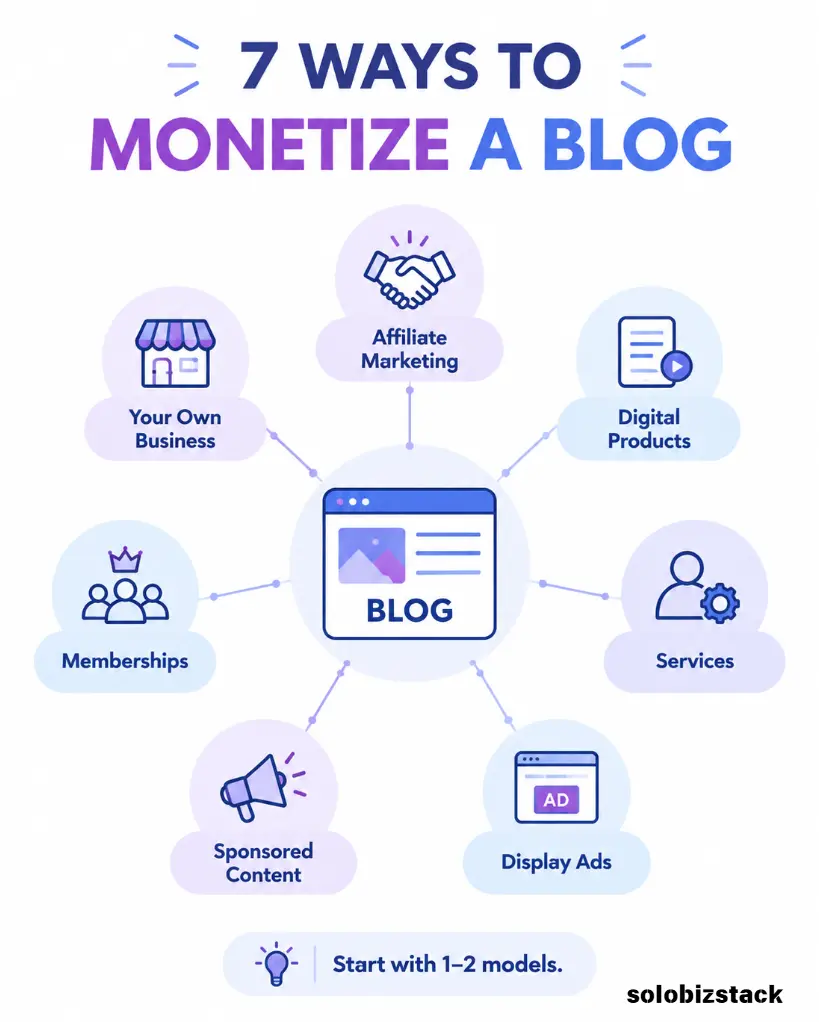
7 Ways Beginners Can Make Money From a Blog
There is no single monetization model that fits every blog.
Here are the main options.
1. Affiliate marketing
You recommend useful products or services and receive a commission when qualifying actions occur.
2. Digital products
You create and sell something such as templates, checklists, ebooks, guides, spreadsheets, or mini-courses.
3. Services
Your blog attracts people who may need help with something you offer.
4. Display advertising
You earn revenue by showing advertisements on your content.
5. Sponsored content
Companies pay to have their products or services featured in content, subject to appropriate disclosure and applicable rules.
6. Memberships or subscriptions
Readers pay for premium content, resources, communities, or other ongoing value.
7. Your own products or business
Your blog can become a marketing channel for software, courses, consulting, ecommerce products, or another business.
You do not need all seven.
A small blog often works better when it starts with one or two models that fit the audience naturally.
1. Affiliate Marketing
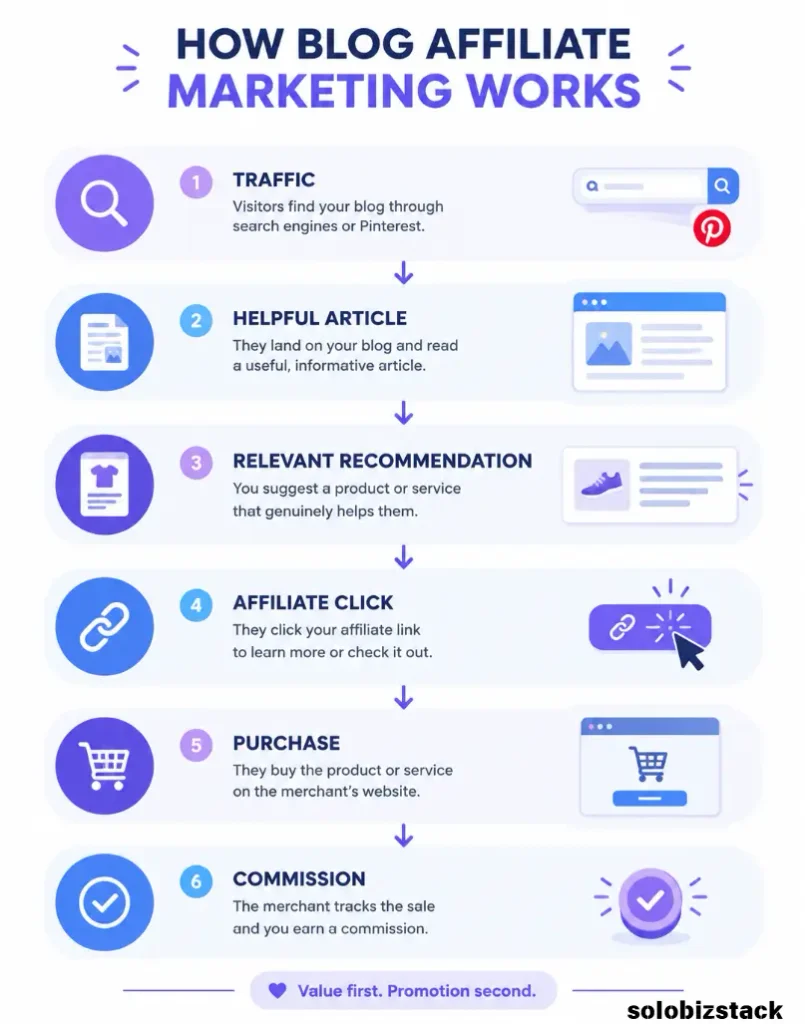
Affiliate marketing is one of the easiest monetization models for a content-focused website to understand.
You publish useful content.
You recommend a relevant product or service.
The reader clicks your link.
If the reader completes a qualifying purchase or action, you may receive a commission according to the affiliate program’s terms.
For example, a beginner website might publish:
Best Website Hosting for Beginners
That article could naturally include links to hosting companies.
A Pinterest article might recommend a design tool.
A blogging article might recommend an SEO tool.
A WordPress tutorial could recommend a theme or plugin.
This works because the recommendation is part of the solution.
The reader already has a problem.
Your article helps them understand their options.
The affiliate link gives them a way to act on the information.
Example Tool Guide: Best Website Hosting for Beginners
For SoloBizStack, affiliate marketing fits particularly well with content such as:
- Hosting reviews
- Hosting comparisons
- WordPress tools
- SEO tools
- AI tools
- Pinterest tools
- Outsourcing services
- Freelance platforms
But affiliate marketing has an important rule
Don’t build articles that exist only to place affiliate links.
Google says sites using affiliate programs should add sufficient value to users; affiliate content that provides little or no additional value can be a problem.
That means your article should add something useful:
A comparison
A tutorial
A real explanation
A clear feature breakdown
A use-case recommendation
A screenshot
A checklist
An honest limitation
The affiliate link should be the next step—not the reason the article exists.
How Much Traffic Do You Need to Make Money With Affiliate Marketing?
There is no magic traffic number.
A smaller website can sometimes generate meaningful affiliate conversions if the visitors have strong purchase intent.
Compare these two articles:
Article A:
50 Interesting Facts About Websites
Article B:
Best WordPress Hosting for Beginners
Article A might attract more casual readers.
Article B may attract fewer people but a much higher proportion of visitors who are actively trying to choose a hosting provider.
That is why traffic quality matters alongside traffic quantity.
For a small affiliate site, I would pay close attention to:
Search intent
Commercial relevance
Click-through rate
Conversion rate
Commission per conversion
Rather than focusing only on raw pageviews.
2. Sell Digital Products
Digital products are another way to monetize a blog.
Instead of recommending someone else’s product, you create something of your own.
Examples include:
- Checklists
- Templates
- Notion templates
- Spreadsheet tools
- Canva templates
- Prompt packs
- Mini-guides
- ebooks
- Printable planners
- Swipe files
- Small courses
The advantage is simple:
You control the product.
You control the pricing.
You control the sales page.
You also have more responsibility.
You need to create something people actually want.
For a SoloBizStack-style website, digital products could fit naturally with topics such as:
Website Launch Checklist
Blog Content Planner
Pinterest Pin Template Pack
Affiliate Content Planning Spreadsheet
Small Website SEO Checklist
Solopreneur Tool Comparison Spreadsheet
The best digital products often solve a problem that your audience has already told you about.
That is why your blog content is valuable even before you sell anything.
Your most popular articles can reveal what people need help with.
3. Sell Services
A blog can also work as a trust-building channel for services.
You do not necessarily need a large audience.
A single useful tutorial can demonstrate that you understand a problem.
For example:
A WordPress tutorial can lead to website setup services.
A Pinterest guide can lead to Pinterest management services.
An SEO tutorial can lead to consulting.
A design article can lead to design services.
A content marketing guide can lead to freelance writing.
The article becomes your proof of knowledge.
That is often more powerful than simply saying:
“I’m an expert.”
Show the reader how you think.
Explain the process.
Help them solve a small part of the problem.
Then offer a service for people who would rather pay someone to handle the entire job.
4. Display Advertising
Display advertising is probably the monetization model most people think about when they hear “make money from a blog.”
You place ads on your website.
A publisher receives revenue based on the advertising model and qualifying activity defined by the ad network.
Google AdSense is one example.
Google’s current AdSense requirements say publishers need their own high-quality, original content, must comply with AdSense policies, must have access to the site they submit, and generally need to be 18 or older to participate directly. Google also reviews the site before it can serve ads.
That means you should not think of AdSense as:
Build a website today → turn on ads tomorrow → earn money.
Your website needs to be properly built, accessible, navigable, and contain enough original content for Google to review. Google specifically notes that sites under construction, sites with little original content, and sites providing thin or low-value content may have approval problems.
Ads can also hurt the user experience
Too many ads can make an article difficult to read.
For a small beginner website, I would prioritize:
Useful content → user experience → monetization
not:
Ads everywhere → more ads → even more ads
Advertising can become more attractive as your traffic grows, but it does not have to be your first monetization method.
5. Sponsored Content
Sponsored content is another option once your website has a defined audience.
A company may pay you to publish or create content related to its product, service, or campaign.
Examples:
- Sponsored tutorial
- Sponsored review
- Brand feature
- Newsletter sponsorship
- Product mention
- Sponsored guide
The important part is transparency.
Sponsored relationships and affiliate relationships should be disclosed clearly when required. The FTC’s Endorsement Guides say material connections should be disclosed clearly and conspicuously, and disclosures should be close enough to the recommendation that readers can understand the relationship.
For a small website, sponsorships are usually something to explore after you’ve developed a defined audience and useful content library.
You don’t need to chase sponsors before you have something worth sponsoring.
6. Memberships and Subscriptions
A membership model means readers pay for ongoing access to something valuable.
That could be:
- Premium articles
- Templates
- A private community
- Monthly research
- Exclusive tutorials
- Resource libraries
- Office hours
- Industry updates
This model can create recurring revenue, but it also creates recurring work.
You need to keep giving members a reason to stay.
For a beginner blog, I would not start here unless you already have a strong audience that wants ongoing access to something specific.
A simple digital product may be easier to launch first.
7. Use the Blog to Build Another Business
Your blog does not have to make money directly from every visitor.
It can also generate customers for something bigger.
For example:
Blog
↓
Free guide
↓
Email list
↓
Product
or:
Blog
↓
Tutorial
↓
Service
or:
Blog
↓
Comparison
↓
Affiliate product
The blog becomes the top of your business funnel.
This is one reason content can be valuable even when the article itself does not generate revenue immediately.
Which Monetization Method Should a Beginner Choose?
The answer depends on the type of blog.
If your blog reviews tools and products
Affiliate marketing makes natural sense.
If you teach a practical skill
Services or digital products may fit well.
If your audience wants downloadable resources
Templates, checklists, spreadsheets, and guides can be a natural fit.
If you have a large amount of traffic
Display advertising becomes more interesting.
If you have a strong niche audience
Sponsorships and memberships may become possibilities.
If your blog supports an existing business
Use it to generate qualified leads.
There can be overlap.
A blog might eventually use affiliate links, digital products, email marketing, and advertising at the same time.
The important thing is not to create five monetization systems before you’ve built one good content system.
The Best Monetization Model for a New Blog
A practical starting point for many content-focused blogs is:
Helpful articles
↓
Affiliate recommendations
↓
Email list
↓
Digital product
↓
Additional monetization
Why this sequence?
Because it allows the business to develop alongside the audience.
You first learn what readers care about.
Then you recommend relevant products.
Then you collect permission to stay in touch.
Then you create something of your own around a proven problem.
Then you have several ways to monetize the same audience.
That is not a rule every blog has to follow.
It is simply a manageable framework for a beginner.
Step 1: Pick a Niche With Monetization in Mind
You do not need to choose a niche only because it has high search volume.
A better question is:
Do people have problems in this niche that can eventually be solved by products, services, or tools?
For example:
Weak starting point
Interesting facts
There may be traffic potential, but the monetization path is unclear.
Stronger business angle
WordPress tools for beginners
Now you have possible products and services around:
Hosting
Themes
Plugins
SEO tools
Design tools
Freelancers
Courses
Templates
That creates more ways to build a business.
Step 2: Build Content Before You Build a Huge Product Catalog
You don’t need ten products.
Start by publishing useful articles.
For example, a WordPress-focused site could create:
How to Build a WordPress Website for Beginners
↓
Best Website Hosting for Beginners
↓
Hostinger Review
↓
Hostinger vs SiteGround
↓
How to Choose a WordPress Theme
↓
WordPress Website Checklist
Now you have a small content cluster.
Some articles educate.
Some compare products.
Some target commercial intent.
Some can naturally recommend products.
That is a stronger foundation than publishing dozens of unrelated “best” lists.
Google’s guidance encourages a clear site purpose and content that leaves visitors satisfied rather than mass-producing pages simply in hopes that some will rank.
Step 3: Join Relevant Affiliate Programs
Once you know which products genuinely fit your readers, research the relevant affiliate programs.
Look for:
- Product relevance
- Commission structure
- Cookie/tracking terms
- Payment terms
- Promotional rules
- Geographic availability
- Brand reputation
- Whether the product genuinely helps your audience
For example, Fiverr currently has an affiliate program where its Marketplace commission plan provides 25% of a first-time buyer’s first order plus 10% revenue share on qualifying future orders for 12 months, subject to its current program terms.
That is relevant to a site like SoloBizStack because Fiverr fits naturally into articles about outsourcing:
Build a website yourself
↓
Need help with design?
↓
Find a freelancer
Don’t choose an affiliate program because the commission looks attractive.
Choose it because the product fits the reader.
A high commission on an irrelevant product is still a poor recommendation.
Step 4: Make Affiliate Recommendations Useful
This is where many beginner affiliate sites go wrong.
They write:
Product A is great.
Product B is great.
Buy Product A here.
That isn’t much of a resource.
Instead, explain:
Who is this product for?
Who should skip it?
What does it solve?
What does it cost?
What are the limitations?
What alternatives exist?
How does it compare with another option?
That is what gives affiliate content value.
The affiliate link becomes one part of a useful buying guide.
Step 5: Create Comparison Content
Comparison articles can be particularly useful because the reader is already trying to make a decision.
Examples:
Rank Math vs Yoast
Canva vs Adobe Express
Tool A vs Tool B
These articles can naturally include affiliate links while still helping the reader understand the trade-offs.
Your goal should not be:
“How do I convince this person to buy?”
It should be:
“How do I help this person make a better decision?”
Trust is an asset.
Protect it.
Step 6: Build an Email List
Search traffic and Pinterest traffic can change.
An email list gives you a way to stay connected with people who have chosen to hear from you.
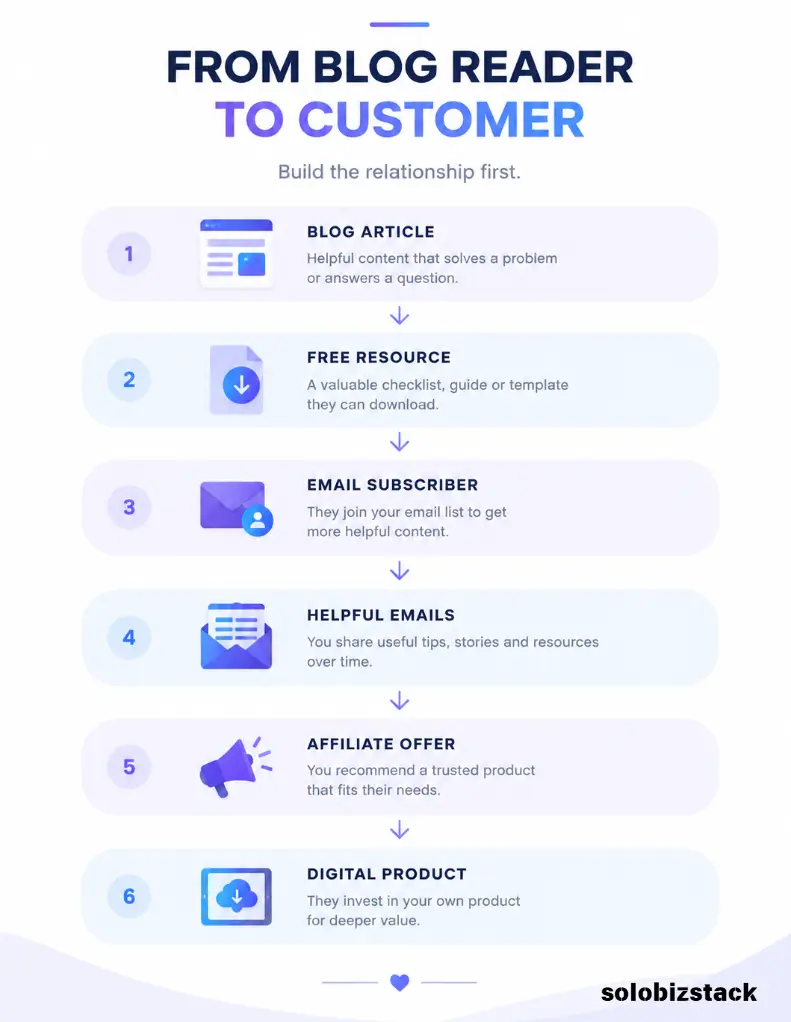
A simple beginner funnel could be:
Blog article
↓
Free checklist
↓
Email signup
↓
Helpful emails
↓
Relevant affiliate recommendation
↓
Digital product
For SoloBizStack, a free resource could be:
WordPress Website Launch Checklist
or:
Blog Monetization Starter Checklist
or:
50 Blog Content Ideas for Beginners
Keep the free resource closely connected to the article.
The closer the relationship, the more useful the email signup feels.
Step 7: Create Your First Digital Product
You do not need to create a 10-hour video course.
Start smaller.
For example:
Product idea 1
WordPress Website Launch Checklist
Product idea 2
Pinterest Pin Template Pack
Product idea 3
Blog Content Planner
Product idea 4
Affiliate Content Planning Spreadsheet
Product idea 5
Small Website SEO Checklist
The best place to discover your first product idea is often your existing content.
Look at the questions people keep asking.
Look at the articles that perform well.
Look at the repetitive tasks readers need to complete.
Then turn one of those problems into a resource.
Step 8: Add Display Ads Later
Ads can be useful, but timing matters.
For a brand-new site, adding advertisements everywhere can make a small amount of traffic even less pleasant to experience.
You also need enough original content and a properly built website before applying to services such as AdSense. Google specifically says AdSense applicants need their own high-quality, original content and a live site that can be reviewed for policy compliance.
So instead of asking:
“How soon can I add ads?”
ask:
“Is my website useful enough that a visitor would want to read several pages?”
If the answer is not yet, keep improving the site.
How Much Money Can a Beginner Blog Make?
This is where you need to be careful with online blogging advice.
There is no reliable number that every beginner can expect.
Revenue depends on:
- Niche
- Traffic
- Search intent
- Audience location
- Affiliate commission
- Conversion rate
- Product pricing
- Email list
- Content quality
- Distribution
- Business model
A website with 1,000 highly relevant visitors can sometimes create more commercial value than a website with 10,000 visitors who are only browsing for entertainment.
That’s why I would avoid setting a goal such as:
“I need 10,000 visitors before I can make money.”
Instead, track smaller milestones.
Milestone 1
First article published.
Milestone 2
First organic visitor.
Milestone 3
First affiliate click.
Milestone 4
First email subscriber.
Milestone 5
First affiliate conversion.
Milestone 6
First digital product sale.
Milestone 7
First month with repeatable revenue.
These milestones tell you much more about the business than a pageview number alone.
A Beginner Blog Monetization Funnel
Here’s a simple model you can use:
Search / Pinterest
        ↓
   Blog Article
        ↓
  Helpful Content
        ↓
 ┌──────┴──────┐
 ↓             ↓
Affiliate    Email Signup
Offer          ↓
        Helpful Emails
              ↓
        Digital Product
              ↓
       More Relevant Offers
The important part is that every step should make sense.
Don’t put an affiliate button in front of someone who has not even understood the problem yet.
Teach first.
Recommend second.
Sell third.
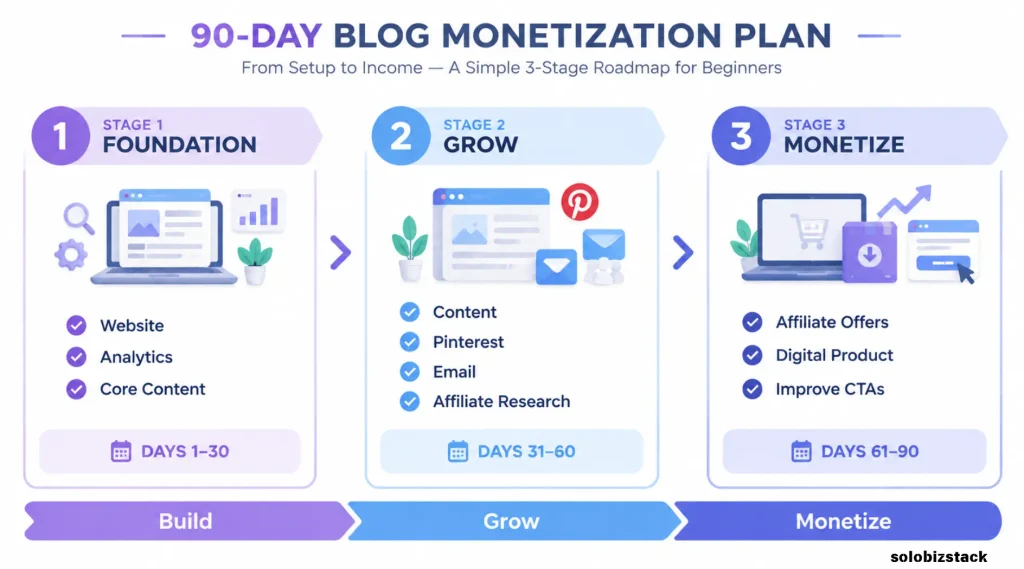
A 90-Day Blog Monetization Plan
If you’re starting from zero, a simple 90-day plan is easier to execute than trying to build everything simultaneously.
Days 1–30: Build the Foundation
Set up:
- Domain
- Hosting
- WordPress
- Theme
- Essential pages
- Analytics
- Search Console
- SEO plugin
Then publish your first group of useful articles.
Days 31–60: Build Content and Distribution
Publish more articles around your core topics.
Create internal links.
Create Pinterest Pins.
Improve older posts.
Start building an email list.
Research relevant affiliate programs.
Don’t add every affiliate link immediately.
Only add products that naturally fit the content.
Days 61–90: Start Monetizing Intentionally
Review which articles are attracting visitors.
Look for commercial-intent topics.
Add relevant affiliate recommendations.
Create your first small digital product.
Improve your best-performing articles.
Test calls to action.
Track clicks and conversions.
At this point, you should have a much clearer idea of what your audience actually cares about.
That’s when monetization gets easier.
How SoloBizStack Can Make Money
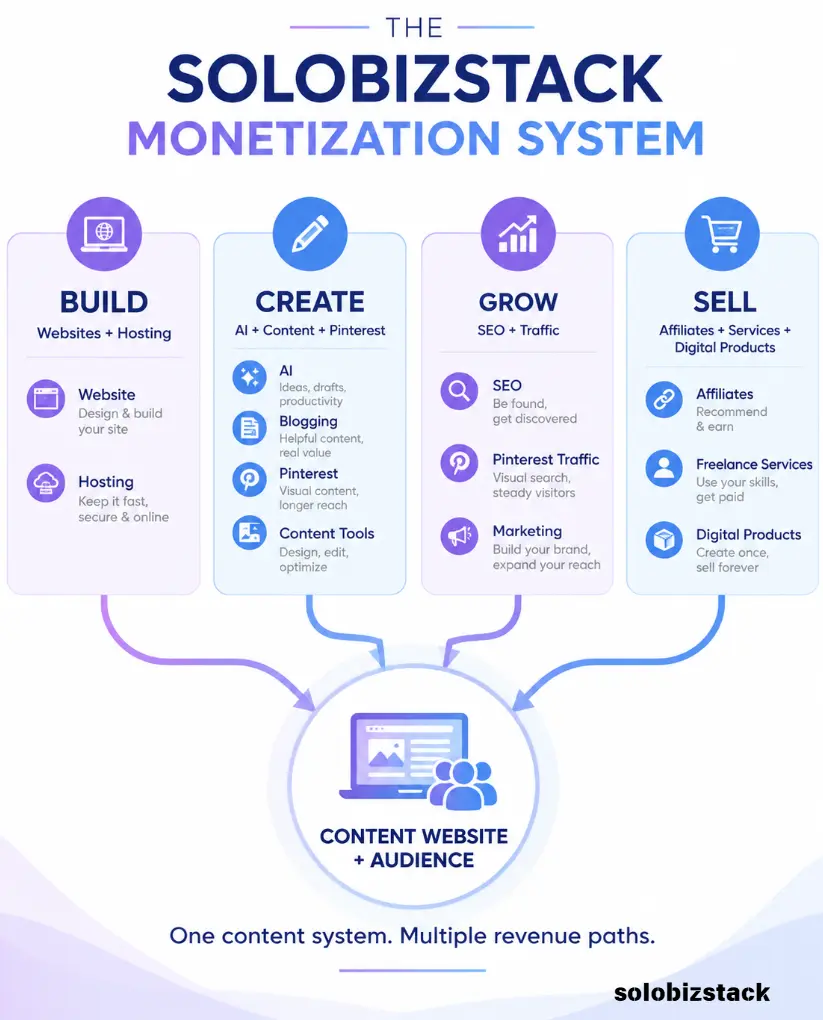
For a website like SoloBizStack, the monetization paths fit together fairly naturally.
Build
WordPress guides and hosting content.
Possible monetization:
Hosting affiliates
Themes
Plugins
Website services
Create
Blogging, AI, Pinterest, and content tools.
Possible monetization:
Software affiliates
Canva
AI tools
Digital templates
Content resources
Grow
SEO, Pinterest, traffic, and marketing.
Possible monetization:
SEO tools
Pinterest tools
Courses
Templates
Affiliate recommendations
Sell
Outsourcing and freelance services.
Possible monetization:
Fiverr
Freelance marketplaces
Services
Digital products
This is one reason the site structure matters.
Your categories aren’t just navigation.
They can also represent different business problems and different monetization opportunities.
Common Beginner Blogging Monetization Mistakes
Trying to monetize before creating useful content
Nobody owes a new blog their money.
Earn attention first.
Using too many affiliate links
More links do not automatically mean more conversions.
Relevance matters.
Recommending products you don’t understand
If you cannot explain who should use the product and why, you’re probably not ready to recommend it strongly.
Publishing thin affiliate articles
Google explicitly warns about sites that provide little additional value around affiliate content.
Add original information.
Add comparisons.
Add useful explanations.
Add screenshots or examples when appropriate.
Putting ads everywhere
A page full of ads may generate some impressions while making the article harder to use.
Chasing every trending topic
Google’s people-first guidance specifically warns against producing content on many topics simply because they appear trending.
Stay close to your website’s main purpose.
Expecting income immediately
Blogging is usually a compounding process.
One useful article can support more articles.
One email subscriber can become a customer later.
One successful affiliate article can reveal an entire content cluster.
Give the system time to develop.
How to Know When Your Blog Is Ready to Monetize
Ask yourself:
Is there enough useful content?
A visitor should be able to read more than one page.
Do I understand my audience?
You should know what problem you’re solving.
Do my recommendations fit?
An affiliate product should make sense in context.
Are my important pages working?
Check forms, links, mobile layout, and navigation.
Is my site trustworthy?
Have a clear About page, Contact page, Privacy Policy, and appropriate disclosures.
Can I measure what happens?
Use analytics and search tools so you know which content is working.
If the answer to most of these is yes, you can begin testing monetization.
Frequently Asked Questions
Can a beginner really make money from a blog?
Yes, but there is no guaranteed timeline or income level. Revenue depends on the niche, audience, traffic, monetization method, conversion rate, and quality of the content and offers.
What is the easiest way to monetize a beginner blog?
For many content-focused websites, affiliate marketing is one of the simplest models to understand because you can recommend existing products without creating your own product first. The key is choosing relevant offers and adding real value rather than publishing thin affiliate pages.
How many blog posts do I need before monetizing?
There is no universal number.
You can add a relevant affiliate link to an early article if it genuinely helps the reader. For larger monetization efforts such as advertising or digital products, it often makes sense to have a broader content base and clearer audience understanding first.
Can I make money with a small amount of blog traffic?
Potentially, yes.
Traffic quality matters. A small amount of highly relevant traffic can be more commercially useful than a large amount of visitors who have no reason to buy anything.
Should I use ads or affiliate marketing first?
It depends on your site.
For a content site focused on products and tools, affiliate marketing can fit naturally into comparisons, reviews, and tutorials. Advertising can be added later as traffic grows. There is no requirement to choose only one model.
Do affiliate links hurt SEO?
Affiliate links themselves are not the main issue. The quality and purpose of the content matter. Google warns against affiliate pages that offer little additional value, while useful content that genuinely helps people can still include commercial relationships.
Do I need to disclose affiliate links?
You should clearly disclose material affiliate relationships. The FTC says affiliate relationships should be disclosed clearly and conspicuously and that the disclosure should be close enough to the recommendation or link for readers to understand the connection.
Is AdSense good for a new blog?
AdSense can be one option, but it is not necessarily the first monetization method to add to a new site. Google currently requires original, high-quality content and reviews sites for policy compliance before ads can be fully activated.
Can I make money from Pinterest traffic?
Pinterest can send visitors to a blog through Pins and destination links. But Pinterest traffic is not guaranteed, so treat it as one acquisition channel alongside search, email, direct traffic, and other relevant sources.
Final Thoughts
Learning how to make money from a blog as a beginner is not really about finding one secret monetization trick.
It is about building a chain of useful decisions.
Choose a clear audience.
Create content that solves real problems.
Build traffic through search, Pinterest, and other relevant channels.
Recommend products that genuinely help.
Build an email list.
Create your own small products when you understand what people need.
Then improve the parts that are already working.
For a site like SoloBizStack, that could look like:
Helpful Guide
↓
Relevant Tool Recommendation
↓
Affiliate Revenue
↓
Email Subscriber
↓
Digital Product
↓
Long-Term Customer
You do not need every step on day one.
Start with useful content.
Then build the business around the problems your readers actually have.
That is a much more sustainable way to turn a blog into something that can eventually make money.
Start Building: How to Build a WordPress Website for Beginners →
Explore Tools: Best SEO Tools for Small Websites →
Grow Traffic: How to Use Pinterest to Drive Traffic to Your Blog →
Monetization results vary. Affiliate programs, advertising requirements, commission structures, and platform policies can change, so always check the current terms before promoting a product.