Affiliate Marketing for Beginners: How It Works
Affiliate marketing is one of the simplest ways to monetize a blog, but it is often explained in a way that makes it sound much easier than it really is.
At its core, affiliate marketing means recommending a product or service and earning a commission when someone makes a qualifying purchase or takes another qualifying action through your referral link.
You do not create the product, handle customer support, or process the transaction. Your job is to connect the right people with useful products and services while creating content that helps them make a better decision.
For beginners, that distinction matters. Affiliate marketing is not simply putting affiliate links on a website and waiting for money to appear. The real work is choosing useful products, creating helpful content, earning traffic, and building enough trust for someone to take action.

This guide explains affiliate marketing for beginners, including how affiliate links work, where the money comes from, what you can promote, how to choose affiliate products, and how to build a simple affiliate marketing system around a blog.
Affiliate Disclosure: This article may contain affiliate links. If you purchase through one of our links, SoloBizStack may earn a commission at no additional cost to you.
What Is Affiliate Marketing?
Affiliate marketing is a performance-based marketing model.
A business gives you a special tracking link. You use that link in your website content, email newsletters, social media, videos, or other approved channels.
When someone clicks your link and completes a qualifying action, the company or affiliate network records the referral and may pay you a commission.
A simple example looks like this:
You publish a helpful article → a reader clicks your affiliate link → they visit the company’s website → they buy a product → the sale is attributed to you → you receive a commission.
The exact rules vary from one affiliate program to another. Some programs pay when a referred customer buys something, while others may pay for a qualified lead, signup, or another action.
The important idea is that your income is connected to results, not simply to publishing a link.
How Does Affiliate Marketing Work?
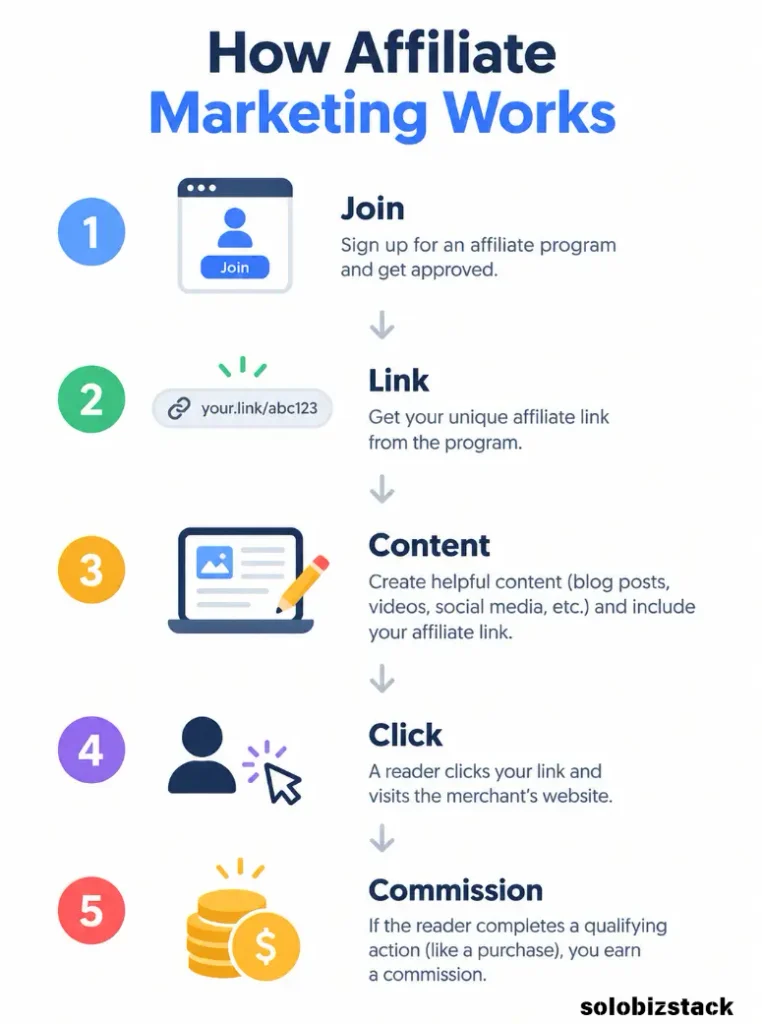
The process is easier to understand when you break it into five steps.
1. You Join an Affiliate Program
First, you apply to an affiliate program offered by a company, retailer, software provider, marketplace, or affiliate network.
Once approved, you receive access to affiliate links, tracking tools, reporting, and program rules.
Some businesses manage their own affiliate programs. Others use affiliate networks to handle tracking and payments.
For a beginner, it is usually easier to start with products and services that naturally fit the content you already want to publish.
2. You Get a Unique Affiliate Link
The affiliate program provides a special URL connected to your account.
That link might look similar to a normal product URL, but it contains tracking information that allows the company or network to identify the referral.
You might place that link behind a button such as:
Check the Current Hosting Options
or:
Explore the Tool
or:
Get Started
The important part is not the button itself. The value comes from the content around it.
A button without useful context rarely gives readers a good reason to click.
3. You Create Useful Content
This is where most of the real work happens.
Instead of publishing random affiliate links, you create content that helps people solve problems or make purchasing decisions.
For example, someone looking for web hosting might search for:
- Best Website Hosting for Beginners
- Hostinger vs SiteGround
- How Much Does It Cost to Build a Website?
- Best WordPress Hosting for a Small Business
These topics naturally create opportunities to recommend relevant services.
The affiliate link becomes part of the solution instead of being the entire purpose of the article.
4. Someone Clicks Your Link
A reader sees your recommendation, decides that the product may be useful, and clicks your affiliate link.
The affiliate system records the referral according to that program’s tracking rules.
Tracking windows vary by company. They can also differ depending on the product, affiliate network, device, and program terms.
That is one reason you should always read the current terms of an affiliate program instead of assuming every program works the same way.
5. The Reader Completes a Qualifying Action
Finally, the reader completes whatever action the program considers commissionable.
In many programs, this means buying a product or service.
The merchant or affiliate network then attributes the conversion to your referral and pays the applicable commission according to its terms.
So the basic model is:
Content → Click → Referral → Conversion → Commission
That is affiliate marketing in its simplest form.
How Do Affiliate Marketers Make Money?
A common misunderstanding is that affiliate marketing pays simply because somebody clicks a link.
That is not how most traditional affiliate programs work.
A click is often only the beginning of the process.
Let’s say you publish a review of a website hosting company.
Your article gets 1,000 visitors.
Out of those visitors:
- 100 click your affiliate link
- 10 become customers
- the affiliate program pays a commission on qualifying purchases
Your income therefore depends on several things at once:
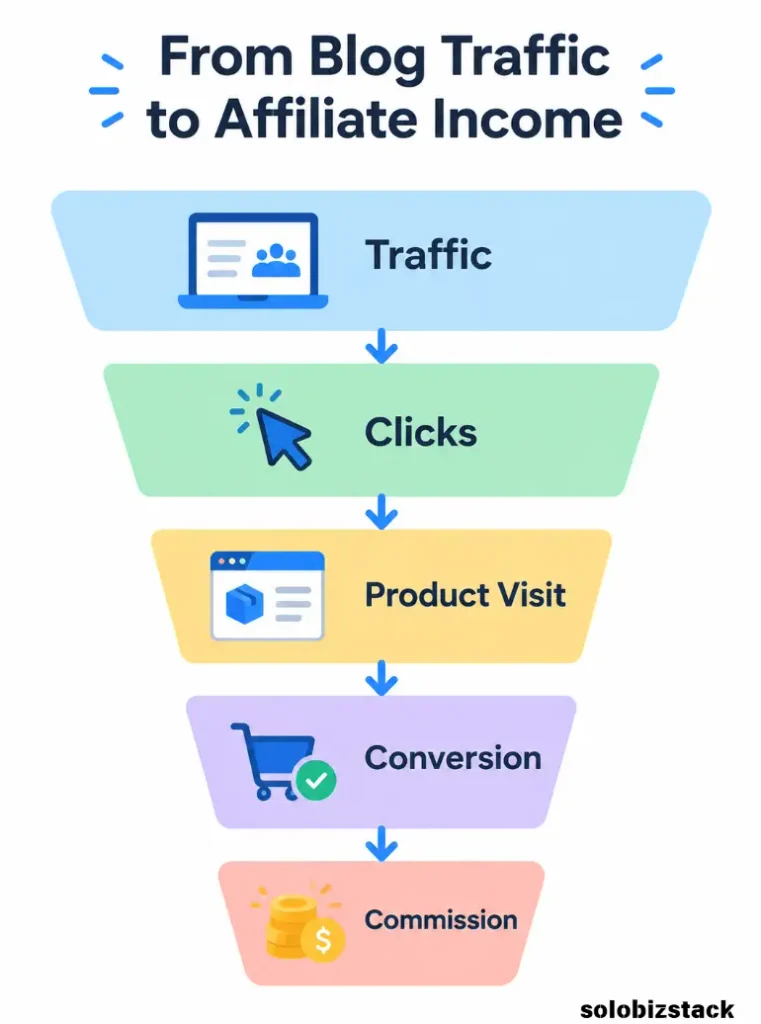
Traffic × Click-Through Rate × Conversion Rate × Commission
You do not necessarily need enormous traffic.
A small website with highly targeted visitors can sometimes outperform a much larger website with people who have no buying intent.
For example, someone searching for “Hostinger vs SiteGround for beginners” is likely much closer to making a hosting decision than someone casually reading an article about “What Is WordPress?”
That is why search intent matters so much in affiliate marketing.
What Can You Promote With Affiliate Marketing?
Almost any product or service that has an affiliate program can potentially be promoted.
For a blog like SoloBizStack, digital products and online services are particularly relevant because they naturally connect with your audience.
Software and SaaS Tools
Examples include:
- WordPress hosting
- SEO tools
- email marketing software
- design platforms
- AI tools
- productivity software
- analytics tools
- website builders
Software can be especially interesting for content websites because one product can support many different articles.
For example, an SEO tool could appear naturally in:
- an SEO tools comparison
- a keyword research tutorial
- a small business SEO guide
- a technical SEO checklist
Freelance and Outsourcing Services
Services are another useful category for solopreneurs.
Instead of teaching readers to do every task themselves, you can show them when outsourcing makes sense.
For example:
- logo design
- website development
- video editing
- copywriting
- SEO services
- translation
- voiceover
- graphic design
This is one reason freelance marketplaces such as Fiverr can fit naturally into a site focused on building and growing an online business.
Physical Products
Traditional retail products can also be monetized through affiliate marketing.
For example, a website about home offices could recommend:
- monitors
- keyboards
- webcams
- desks
- microphones
- lighting
The important thing is relevance.
You should be able to explain why the product is useful to your audience rather than simply adding products because they offer commissions.
Digital Products
Digital products can include:
- online courses
- templates
- ebooks
- memberships
- design assets
- business resources
- productivity systems
These products can fit especially well with tutorial-based content because readers are often looking for a faster or more complete solution.
How to Choose the Right Affiliate Products
One of the biggest beginner mistakes is choosing products based on commission rates alone.
A 30% commission on a product nobody wants is less useful than a smaller commission on a product that genuinely solves a problem for your audience.
A better way to evaluate an affiliate product is to ask five questions.
1. Does My Audience Actually Need It?
Start with your reader, not the commission.
If your audience is made up of beginner bloggers, web hosting, WordPress tools, SEO tools, design software, and Pinterest tools may make sense.
A completely unrelated product probably does not.
2. Does It Solve a Real Problem?
The strongest affiliate content usually starts with a problem.
For example:
Problem: I need a website but do not know where to start.
Solution: A beginner-friendly hosting service and WordPress setup guide.
Or:
Problem: I need Pinterest graphics but cannot hire a designer.
Solution: A design tool plus a step-by-step tutorial.
This creates a natural connection between the article and the affiliate recommendation.
3. Can You Explain Its Benefits Clearly?
You do not have to personally use every product you mention, but you should be able to research it responsibly and explain what it does, who it is for, and where its limitations are.
Avoid simply rewriting the company’s sales page.
Readers can already visit the company’s website.
Your value comes from helping them understand the product.
4. Is the Program Reliable?
Before joining an affiliate program, check:
- commission rules
- cookie or tracking period
- payout threshold
- payment method
- geographic restrictions
- prohibited promotional methods
- refund or cancellation rules
- brand usage requirements
Program terms can change, so check the official affiliate documentation before publishing specific commission figures.
5. Does the Product Fit Your Content Strategy?
This is an important one.
Suppose you have an article about building a WordPress website.
That article can naturally connect to:
- web hosting
- WordPress themes
- SEO plugins
- forms
- analytics
- website security
- design tools
One useful product can therefore support an entire content cluster.
That is much stronger than creating one article for every random affiliate product you discover.
The Best Types of Affiliate Content for Beginners
Not every blog post is equally useful for affiliate marketing.
Some content types naturally lead to buying decisions.
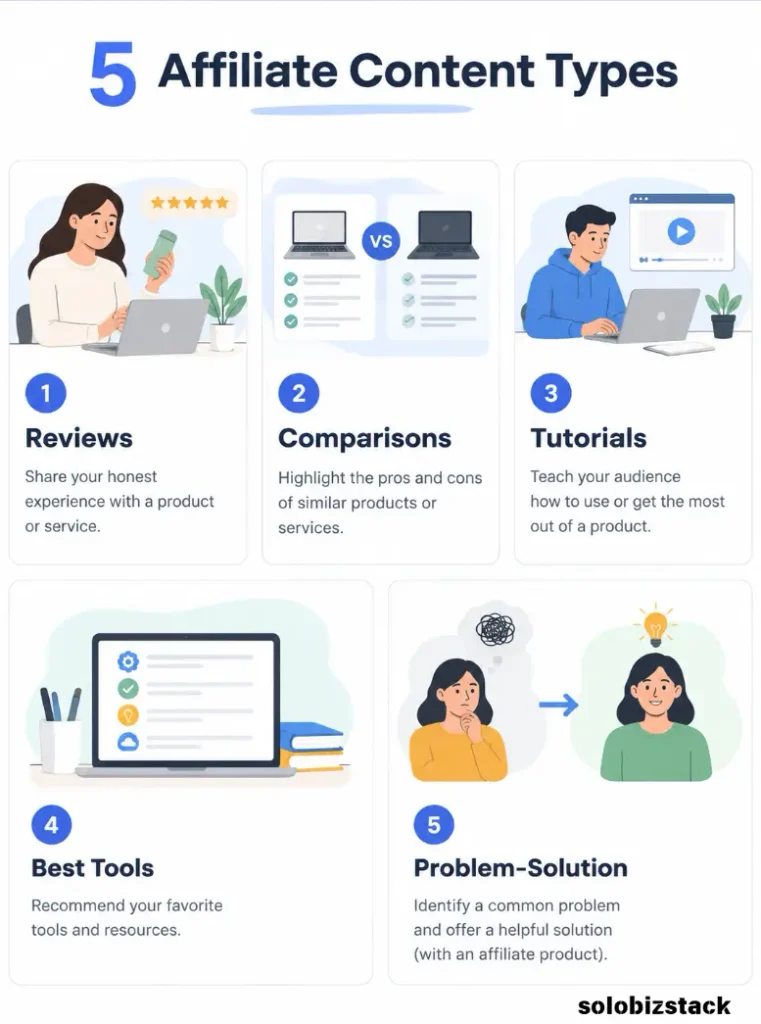
Product Reviews
Example:
Hostinger Review: Is It Good for Beginners?
A review allows you to explain who the product is for, its strengths, limitations, pricing, setup process, and alternatives.
Comparisons
Example:
Hostinger vs SiteGround: Which Web Host Is Better for Beginners?
Comparison content is powerful because the reader is already evaluating options.
Tutorials
A tutorial can introduce a relevant product as part of solving a problem.
For example:
How to Create Pinterest Pins for Your Blog
could naturally recommend a design tool.
The article is useful even if the reader does not purchase anything.
That is exactly how affiliate content should work.
“Best Tools” Articles
Examples:
- Best SEO Tools for Small Websites
- Best Tools for Creating Pinterest Pins
- Best AI Tools for Solopreneurs
These articles can work well when each recommendation includes meaningful information rather than a list of affiliate links.
Problem-Solution Articles
This is one of my favorite formats for a beginner affiliate website.
Start with a problem.
Explain why it happens.
Show possible solutions.
Compare approaches.
Then recommend relevant tools when appropriate.
The reader gets value whether or not they click your affiliate link.
Affiliate Marketing and SEO: Why Search Intent Matters
SEO traffic is useful for affiliate marketing because many searches happen when people are trying to solve a problem or compare options.
Consider these two searches:
What is SEO?
and
Best SEO tools for a small website
The first is mainly informational.
The second has stronger commercial intent.
Neither is automatically better. They simply serve different purposes.
Read Google’s People-First Content Guidance →
A strong affiliate website usually needs a mixture of content:
Informational content → builds trust and traffic
Commercial content → helps readers evaluate products
Transactional content → captures users ready to take action
The goal is not to turn every article into a sales page.
Instead, build a content journey where informational articles naturally connect to relevant commercial content.
For example:
Pinterest Keyword Research for Beginners
↓
Pinterest SEO for Beginners
↓
How to Use Pinterest to Drive Traffic to Your Blog
↓
Best Tools for Creating Pinterest Pins
↓
Affiliate recommendation
That is a much more natural monetization path than putting the same affiliate button in every article.
How to Get Traffic to Affiliate Content
Affiliate marketing only works when people actually see your content.
For a beginner blog, there are several practical traffic sources.
Google Search
Search-focused content can bring visitors who are actively looking for answers, comparisons, reviews, and tools.
This is why keyword research and search intent matter.
But do not write hundreds of thin pages simply because a keyword exists.
Your content should have a clear purpose and add something useful beyond what readers could get from a basic product page.
Pinterest can be particularly useful for visual tutorials, blogging content, online business topics, templates, and guides.
For SoloBizStack, Pinterest can support articles about:
- WordPress
- blogging
- SEO
- AI tools
- content creation
- Pinterest marketing
- online business
A Pin should create a reason to visit the article rather than making the entire article unnecessary.
Email gives you another way to build an audience you can reach repeatedly.
For example, you could publish:
5 Tools Every New Blogger Should Know
and invite readers to join your email list for a longer beginner toolkit.
Later, you can recommend relevant products when they genuinely fit the reader’s needs.
Internal Linking
Internal linking is often overlooked by beginners.
A visitor who lands on one article should have an obvious next step.
For example:
A hosting article can link to your WordPress beginner guide.
That article can link to your WordPress checklist.
The checklist can link to SEO tools.
The SEO article can link to affiliate-friendly software comparisons.
This turns individual articles into a system.
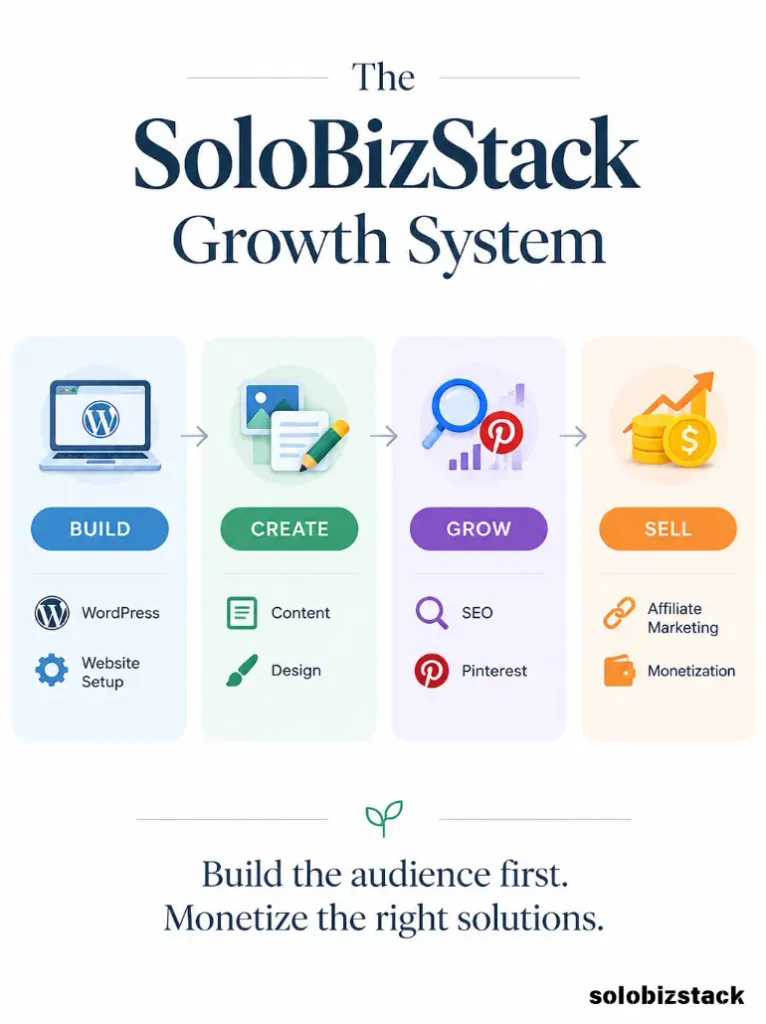
The SoloBizStack Affiliate Marketing Funnel
For SoloBizStack, a simple affiliate funnel could look like this:
Build
Help readers create a website.
↓
Create
Help them create content, graphics, and Pinterest Pins.
↓
Grow
Help them attract visitors through SEO and Pinterest.
↓
Sell
Show them tools, services, outsourcing options, and monetization strategies.
↓
Affiliate Recommendation
Recommend a relevant product only when it helps solve the problem discussed in the article.
This structure makes your affiliate strategy feel like part of the website rather than an advertisement placed on top of it.
How to Add Affiliate Links Without Making Your Blog Feel Spammy
This is where many affiliate blogs go wrong.
They add affiliate buttons after every paragraph.
They mention the same product repeatedly.
They use aggressive phrases like “Buy Now” even when the reader is still learning.
Eventually, the article feels like an advertisement.
A better approach is to place affiliate recommendations at natural decision points.
For example:
Need beginner-friendly hosting? Compare the options and choose the one that fits your website.
[CTA Button: Compare Hosting Options]
Or:
Creating your own blog graphics can take time. A simple design tool can help you create featured images and Pinterest graphics without starting from scratch.
[CTA Button: Explore the Design Tool]
The button should make sense because of what the reader just learned.
That is the difference between a helpful recommendation and an intrusive promotion.
Affiliate Disclosure: What Beginners Need to Know
Transparency matters.
When you earn money because someone purchases through your recommendation, readers should be able to understand that relationship.
The U.S. Federal Trade Commission says affiliate relationships should be disclosed clearly and conspicuously, and the disclosure should be close enough to the recommendation or affiliate link that readers can understand the connection. Simply writing “affiliate link” may not always communicate the relationship clearly enough.
A straightforward disclosure is usually easier for readers to understand:
This post contains affiliate links. If you purchase through one of these links, we may earn a commission at no extra cost to you.
Also remember that individual affiliate programs can have additional disclosure requirements.
For example, Amazon Associates currently requires participants to identify themselves with its specified associate disclosure in addition to following applicable disclosure requirements.
Always read the current terms of the specific program before publishing affiliate content.
Read the FTC Affiliate Disclosure Guidance →
Common Affiliate Marketing Mistakes Beginners Make
Mistake #1: Choosing Products Because They Pay Well
Commission should be one factor, not the deciding factor.
Start with audience relevance.
Mistake #2: Publishing Thin Product Reviews
Copying a product description and adding an affiliate button does not create a valuable review.
Add comparisons, use cases, limitations, setup information, alternatives, screenshots where appropriate, and practical advice.
Mistake #3: Promoting Too Many Products
You do not need 30 affiliate programs.
You might only need a small group of tools that genuinely fit your website.
A focused affiliate stack is easier to explain, maintain, and update.
Mistake #4: Focusing Only on Product Keywords
Commercial keywords are valuable, but informational content helps build the audience that eventually reaches those commercial pages.
Think in terms of topic clusters rather than isolated keywords.
Mistake #5: Promising Easy Passive Income
Affiliate marketing can create recurring or semi-automated revenue in some business models, but it still requires work.
You need useful content, traffic, maintenance, testing, and trust.
There is no guarantee that publishing a certain number of articles will produce a specific amount of income.
Mistake #6: Ignoring Program Rules
Affiliate programs can restrict:
- paid advertising
- brand bidding
- coupon use
- email promotions
- trademark usage
- link placement
- certain traffic sources
Always check the current program agreement.
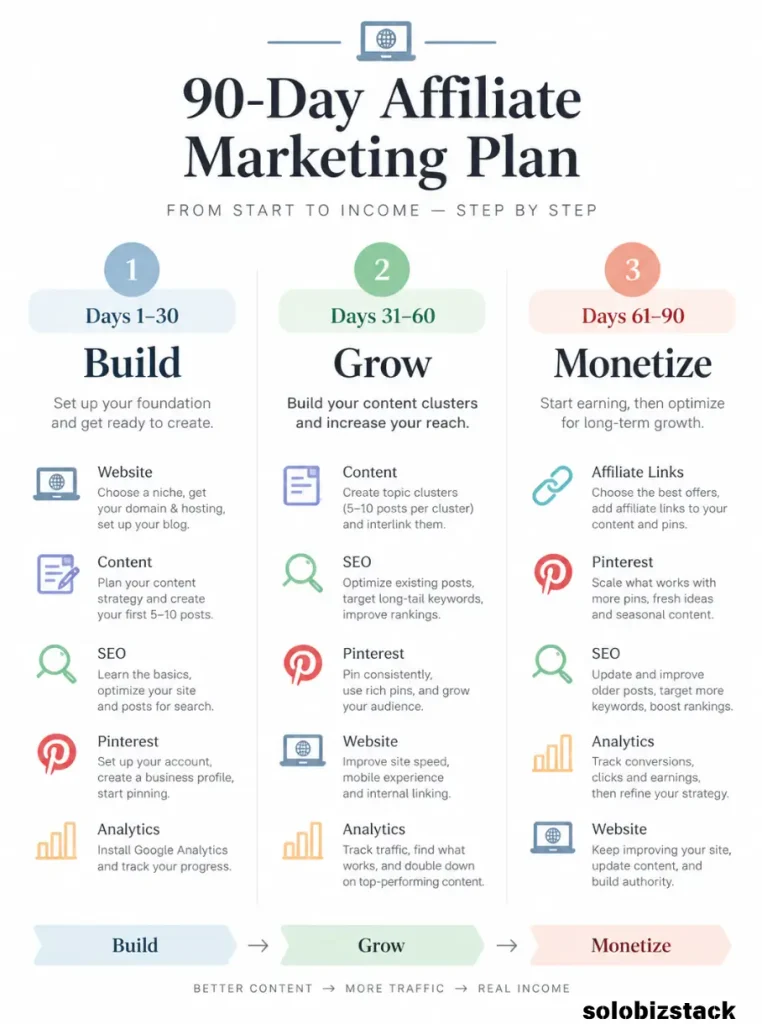
A Simple 90-Day Affiliate Marketing Plan
You do not need to join 50 affiliate programs on day one.
A better approach is to build a small foundation first.
Days 1–30: Build the Foundation
Create your website structure.
Publish useful beginner content.
Choose one main audience.
Choose a small number of categories that naturally connect.
For SoloBizStack, that can be:
Build → Create → Grow → Sell
Then identify products and services that genuinely fit those topics.
Days 31–60: Build Content Clusters
Start connecting your articles.
For example:
How to Build a WordPress Website
↓
Best Website Hosting for Beginners
↓
Hostinger vs SiteGround
↓
How to Choose a WordPress Theme
↓
WordPress Website Checklist
Each article should have a clear next step.
At the same time, create Pinterest Pins and begin measuring which topics attract clicks.
Days 61–90: Improve Monetization
Look at your data.
Which articles get traffic?
Which pages generate clicks?
Which affiliate links get attention?
Which content receives Pinterest engagement?
Then improve the pages that already show potential.
You might add:
- better comparison tables
- stronger calls to action
- clearer internal links
- additional examples
- better screenshots
- updated pricing information
- alternative products
- FAQ sections
This is usually more productive than publishing another 30 random articles.
A Simple Affiliate Website Model for Beginners
Imagine you are starting a small website about blogging.
Your content could look like this:
Build
How to Build a WordPress Website for Beginners
Potential monetization:
Hosting
WordPress theme
Plugins
Domain services
Create
How to Create Blog Images Without a Designer
Potential monetization:
Design tools
AI image tools
Template platforms
Grow
Best SEO Tools for Small Websites
Potential monetization:
SEO software
Keyword research tools
Analytics platforms
Sell
Affiliate Marketing for Beginners: How It Works
Potential monetization:
Affiliate tools
Email marketing platforms
Courses
Digital products
Freelance services
The key is that the affiliate product supports the content strategy.
You are not building an affiliate website and then looking for something to write about.
You are building a useful website first and choosing monetization methods that naturally fit it.
What Should You Promote First?
For a new website, I would start with products that are closely connected to the problems you already cover.
For SoloBizStack, that means categories such as:
Website hosting
WordPress tools
SEO software
Design tools
Pinterest tools
AI productivity tools
Freelance and outsourcing services
Digital products
You can then create reviews, comparisons, tutorials, and problem-solving guides around those categories.
Over time, you can see which topics attract the right audience and which products actually generate clicks and conversions.
That data should influence what you publish next.
How Much Traffic Do You Need to Make Money With Affiliate Marketing?
There is no universal traffic number that guarantees affiliate income.
A website with 500 highly targeted visitors can behave very differently from a website with 20,000 visitors who have little interest in the products being promoted.
For affiliate marketing, intent often matters more than raw traffic.
A visitor searching for:
“best email marketing software for beginners”
is potentially more commercially valuable than a visitor searching for:
“what is email marketing?”
Again, both types of content are useful.
The first can support a direct comparison or recommendation.
The second can introduce the reader to the topic and move them further into your content funnel.
The goal is to build both traffic and intent over time.
Can You Make Money With Affiliate Marketing Without a Huge Audience?
Yes, a huge audience is not a requirement.
But that does not mean you can skip the hard work.
A smaller audience can still be valuable when it is:
- relevant
- targeted
- engaged
- actively looking for solutions
- likely to trust the site’s recommendations
For a beginner, I would rather build a small website around one clear audience than create a giant website that talks about everything.
A focused website also makes internal linking, content planning, Pinterest promotion, email marketing, and affiliate selection easier.
Affiliate Marketing Tools You May Eventually Need
You do not need an expensive stack in the beginning.
A simple setup might include:
WordPress for your website.
Rank Math for on-page SEO.
Pretty Links or another link-management solution for managing affiliate URLs where appropriate.
Google Search Console for search performance.
Google Analytics for traffic analysis.
Pinterest Analytics for Pinterest performance.
Canva or another design platform for Pins and visual content.
As your site grows, you can add more specialized tools.
The important thing is to avoid buying tools simply because they are recommended by another affiliate marketer.
Only add a tool when it solves a problem you actually have.
Frequently Asked Questions
What is affiliate marketing?
Affiliate marketing is a performance-based marketing model where you earn a commission when someone completes a qualifying action through your referral link.
How does affiliate marketing work for beginners?
A beginner joins an affiliate program, receives a tracking link, creates useful content, attracts relevant visitors, and earns a commission when qualifying actions are attributed to their referral.
Is affiliate marketing good for beginners?
Affiliate marketing can be a practical monetization model for beginners because you can promote existing products instead of creating your own product from scratch.
However, it still requires content creation, traffic generation, research, and trust.
How much money can a beginner make with affiliate marketing?
There is no fixed amount.
Income depends on traffic, audience intent, click-through rate, conversion rate, commission structure, and the products being promoted.
Some websites make little or no money for a long time before finding a profitable content and traffic combination.
Do I need a website for affiliate marketing?
Not always.
Some affiliate programs allow promotion through social media, email, video, or other approved channels.
For SoloBizStack, however, a website provides a strong foundation because you can build search traffic, internal links, evergreen content, email capture, and multiple monetization paths around the same audience.
Do affiliate marketers need to buy the products they promote?
Not necessarily.
But you should avoid pretending to have personal experience that you do not have.
When you have not personally used a product, clearly separate your own experience from information based on official documentation, testing, demonstrations, or research.
How many affiliate links should a blog post have?
There is no universal number.
Use affiliate links where they help the reader take the next logical step.
A short article may need only one or two.
A detailed comparison may naturally need more.
Relevance matters more than quantity.
What is the easiest affiliate product to promote?
There is no single easiest product.
A good starting point is usually a product that solves a clear problem for the audience you already understand and fits naturally into your content.
Can Pinterest be used for affiliate marketing?
Pinterest can be part of an affiliate marketing strategy, but you need to follow Pinterest’s current policies, applicable affiliate program rules, and disclosure requirements.
For a content site, one practical approach is to use Pinterest to drive visitors to useful articles where relevant affiliate recommendations appear naturally.
Final Thoughts
Affiliate marketing becomes much easier to understand once you stop thinking of it as “put links on a website and make money.”
The real model is:
Find a useful problem → create helpful content → attract the right audience → recommend a relevant solution → earn a commission when a qualifying action happens.
For a beginner blog, that process takes time.
You need content people actually want.
You need traffic from search, Pinterest, email, or other channels.
You need products that genuinely fit your audience.
And you need enough trust for readers to believe that your recommendations are worth considering.
That is the approach behind SoloBizStack.
Build something useful first.
Create content that solves real problems.
Grow the audience.
Then monetize the traffic with products and services that genuinely make sense for the reader.
That creates a much stronger foundation than chasing the highest commission you can find.