How to Start Affiliate Marketing With a Small Website
You do not need a huge website, thousands of daily visitors, or dozens of affiliate partnerships to start affiliate marketing. In fact, a small website can be a good place to begin because it lets you focus on one audience, a few useful topics, and products that actually fit the problems your readers are trying to solve.
The bigger challenge is knowing what to do first.
Many beginners join affiliate programs before they have a clear niche, publish a few product links, and then wonder why nothing happens. The problem usually is not the size of the website. It is the lack of a clear connection between the audience, the content, the product, and the buying decision.
So, how to start affiliate marketing with a small website?
The simplest approach is to build a useful website first, choose a narrow audience, create content around real problems, and introduce relevant affiliate products where they genuinely help.
This guide walks through that process step by step, from choosing your niche and finding affiliate programs to creating content, getting traffic, adding affiliate links, and improving your first pages.

Affiliate Disclosure: This article may contain affiliate links. If you purchase through one of our links, SoloBizStack may earn a commission at no additional cost to you.
Can a Small Website Really Make Money With Affiliate Marketing?
Yes, but there is an important difference between small and empty.
A small website might have only a handful of focused articles, but those articles can answer very specific questions for a clearly defined audience.
A new site about “online business” is broad.
A site focused on “simple tools for beginner bloggers” is much easier to understand.
The second site may have fewer visitors, but those visitors can be more relevant to the products being recommended.
That is why traffic volume is only one part of affiliate marketing. What matters just as much is who is visiting, what they are looking for, and how closely your recommendation matches that need.
You also do not need to wait until you have hundreds of articles before monetizing. What you need is enough useful content to make the site credible and to create a natural path between informational articles and relevant products.
[Learn How Affiliate Marketing Works →]
Why Small Websites Can Be Good for Affiliate Marketing
A small website has one major advantage: focus.
When you are running a huge general-interest website, it is difficult to become genuinely useful across dozens of unrelated subjects.
A smaller site can go deeper into one problem.
For example, instead of covering every type of online business, you could focus on helping beginner solopreneurs build websites, create content, attract traffic, and choose the right tools.
That gives you a much clearer content strategy.
It also makes your recommendations easier to understand.
A reader who visits a site because they want to start a blog is much more likely to care about hosting, WordPress tools, SEO software, design platforms, Pinterest tools, and outsourcing services than about a completely unrelated product.
The goal is not to make your website look big.
The goal is to make it useful enough that a small audience has a reason to trust it.
What You Need Before Starting Affiliate Marketing
You do not need a complicated business setup.
For a simple content-based affiliate website, you need four basic pieces:
A clear audience
You need to know who the website is for.
A useful topic
Your site should solve problems within a specific subject area.
Useful content
You need articles that answer questions, compare options, explain processes, or help readers make decisions.
Relevant products
Your affiliate recommendations should naturally connect to the problems your content solves.
That is enough to get started.
You can add email marketing, Pinterest scheduling, analytics tools, link management, and other systems later.
Starting with too many tools often creates more work than value.
Step 1: Choose a Small, Specific Niche
The first real decision is your niche.
A niche is simply the area your website focuses on.
For example:
Broad: Online Business
More focused: Blogging
More focused: Blogging for beginners
Even more focused: Tools and systems for beginner solopreneurs
You do not necessarily need the smallest niche possible.
You need a niche that is focused enough to build authority while still giving you enough topics and products to work with.
A Simple Niche Test
Ask yourself four questions:
Can I create at least 30 useful article ideas?
If you can only think of five topics, the niche may be too narrow.
Does the audience have recurring problems?
Problems create content opportunities.
Are there useful products or services that solve those problems?
This is important for affiliate monetization.
Can I explain the topic clearly?
You do not need to be the world’s leading expert, but you should be able to research the topic carefully and add useful context.
For SoloBizStack, this is why categories such as Build, Create, Grow, and Sell work well together. They are different topics, but they serve the same broader audience: people trying to build and grow an online business.
Step 2: Find Problems Before You Find Products
This is one of the most useful rules for beginner affiliate marketing.
Do not start with:
“What affiliate program should I join?”
Start with:
“What problems does my audience have?”
For example, a beginner blogger might have questions like:
- How do I build a website?
- Where should I host it?
- Which WordPress theme should I use?
- How do I create blog images?
- How can I get traffic?
- Which SEO tools are worth using?
- How can I create Pinterest Pins?
- How can I monetize my blog?
Each question can become an article.
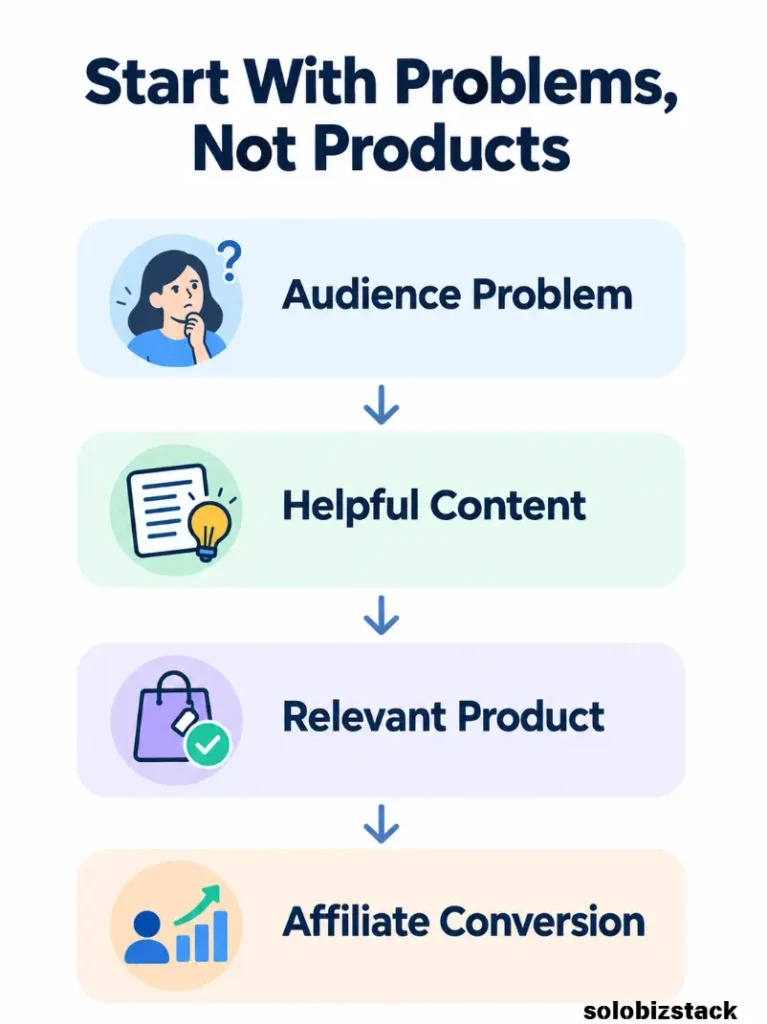
Then, once you understand the problem, you can identify tools or services that genuinely help solve it.
This approach keeps affiliate marketing connected to your content instead of turning your website into a collection of random product recommendations.
Step 3: Find Affiliate Programs That Fit Your Audience
Once you know what your readers need, start looking for affiliate programs.
You can find programs through:
- a company’s own website
- affiliate networks
- software partner programs
- marketplaces
- creator platforms
- digital product platforms
Start small.
You might only need five to ten relevant programs at the beginning.
The quality of the match is more important than the number of affiliate accounts you have.
What to Check Before Joining
Read the affiliate program terms carefully.
Look at:
Commission structure
Understand exactly what action generates a commission.
Tracking period
Some programs use a limited cookie or attribution window.
Payout rules
Check payment methods and minimum payout requirements.
Traffic restrictions
Some programs restrict paid ads, email promotions, coupon sites, brand bidding, or other traffic sources.
Geographic restrictions
Some offers may only be available in certain countries or regions.
Product fit
Even a generous commission is not useful if the product has little connection to your audience.
For example, Fiverr’s current affiliate program states that commissions are paid for new buyers’ first purchases rather than clicks or registrations, and its current Marketplace plan is listed as 25% of the first-time buyer amount plus 10% revenue share on qualifying later orders for 12 months. Fiverr also currently documents a 30-day tracking cookie. Program terms can change, so check the official terms when you actually join.
[Affiliate CTA Button: Explore Fiverr Freelance Services →]
Use your Fiverr affiliate link here after approval.
Step 4: Pick a Few Products Instead of Dozens
One of the easiest ways to make a small affiliate website look spammy is to promote everything.
You do not need 50 affiliate products.
Imagine a beginner website-building audience.
You might have:
One hosting recommendation
One or two WordPress-related tools
One SEO tool
One design tool
One outsourcing platform
That is already enough to build many useful articles.
The same product can also appear naturally across several related pieces of content.
For example, a hosting service might be relevant to:
- How to Build a WordPress Website
- Best Website Hosting for Beginners
- Hostinger Review
- Hostinger vs SiteGround
- How Much Does It Cost to Build a Website?
This creates a content cluster instead of a collection of disconnected affiliate pages.
Step 5: Build Content Around Buying Decisions
Not every article needs an affiliate link.
This is an important distinction.
Some content should simply answer questions.
Other content should help readers compare options.
And some content can lead directly to a product recommendation.
Think of your content in three levels.
Informational Content
These articles answer questions.
Examples:
What Is WordPress?
What Are Hip Flexors?
How Does Affiliate Marketing Work?
The reader is learning.
Commercial Content
These articles help readers evaluate products.
Examples:
Best SEO Tools for Small Websites
Best Website Hosting for Beginners
Best Tools for Creating Pinterest Pins
The reader is considering options.
Decision-Focused Content
These articles help readers choose.
Examples:
Hostinger vs SiteGround
Rank Math vs Yoast
Hostinger Review: Is It Good for Beginners?
The reader is much closer to taking action.
A healthy small website can use all three types.
Step 6: Create Articles That Actually Add Value
A common mistake is to create an article by copying information from the merchant’s website.
That does not give the reader much reason to visit your page.
Google’s guidance specifically warns against affiliate pages that simply reproduce merchant descriptions without meaningful original value. Good affiliate content should add useful information, comparisons, analysis, ratings, testing, navigation, or other substantial value.
So instead of writing:
“This hosting company provides fast and reliable web hosting.”
Explain:
- who it is best for
- who should avoid it
- how easy it is for beginners
- what features matter
- what the alternatives are
- what the important limitations are
- what type of website it fits
Your job is not to rewrite a sales page.
Your job is to help the reader make a better decision.
[See the Best Website Hosting Options →]
Step 7: Use Reviews, Comparisons, and Tutorials
Three content formats are particularly useful for a small affiliate website.
Reviews
A review answers:
“Is this product right for me?”
A good review should include the strengths, weaknesses, ideal user, key features, pricing considerations, alternatives, and your reasoning.
Comparisons
A comparison answers:
“Which option should I choose?”
Examples:
Hostinger vs SiteGround
Rank Math vs Yoast
Kadence vs Elementor
Comparison content is valuable because the reader already has a decision to make.
Tutorials
A tutorial answers:
“How do I solve this problem?”
For example:
How to Create Pinterest Pins for Your Blog
could naturally introduce a design tool.
The article remains useful even if the reader never clicks the affiliate link.
That is exactly what you want.
Step 8: Create a Simple Content Funnel
A small website becomes much more powerful when its articles are connected.
Imagine this path:
How to Start a Blog
↓
How to Build a WordPress Website
↓
Best Website Hosting for Beginners
↓
Hostinger vs SiteGround
↓
Hosting Recommendation
Now imagine another path:
Pinterest Keyword Research for Beginners
↓
Pinterest SEO for Beginners
↓
How to Use Pinterest to Drive Traffic to Your Blog
↓
Best Tools for Creating Pinterest Pins
↓
Design Tool Recommendation
The visitor moves from learning to solving a problem and finally to evaluating a product.
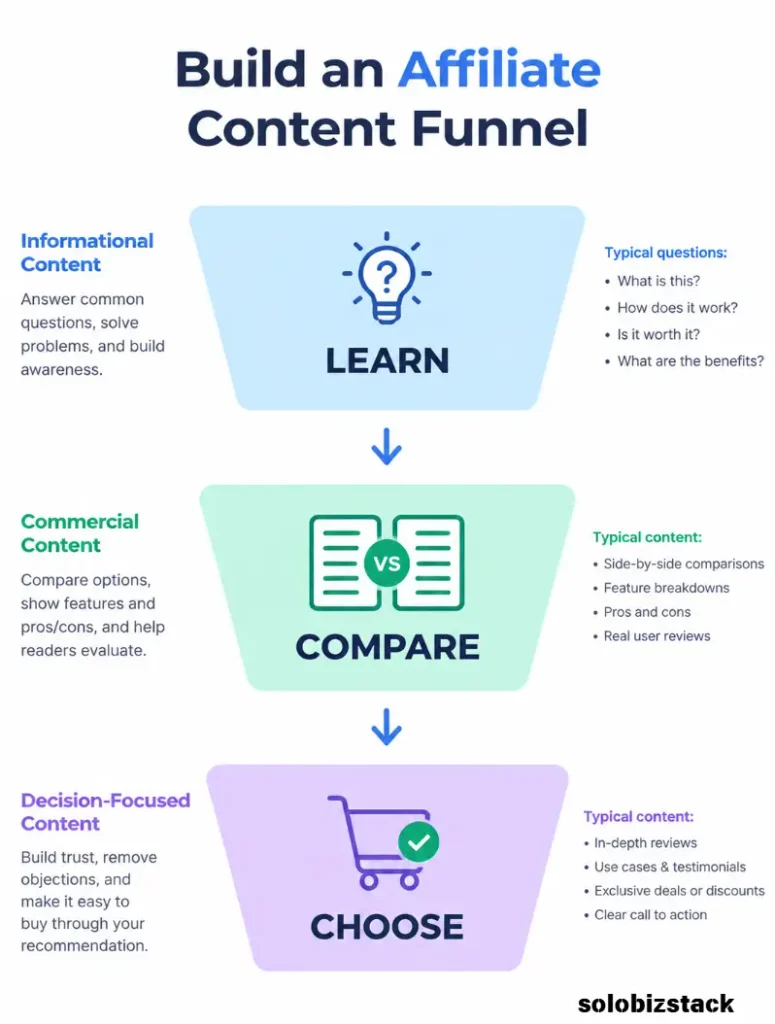
You are not forcing the sale.
You are simply giving the reader the next useful step.
[Build Your WordPress Website →]
Step 9: Add Affiliate Links at the Right Moment
There is no magic number of affiliate links that every article should contain.
A better question is:
Does this link help the reader at this point?
Suppose you just explained why beginners need reliable hosting.
That is a natural place for a hosting recommendation.
Suppose you are explaining how to create Pinterest graphics.
That is a natural place for a design-tool recommendation.
But inserting a completely unrelated affiliate product halfway through a paragraph usually feels forced.
Use affiliate links at decision points.
For buttons, use clear language such as:
Explore the Tool →
Check Current Pricing →
Compare Hosting Options →
View Freelance Services →
See the Recommended Option →
Avoid making every button look like an aggressive sales pitch.
Step 10: Add Affiliate Disclosures Clearly
Affiliate disclosure is not something to hide in the footer.
The FTC says affiliate relationships should be disclosed clearly and conspicuously, and the disclosure should be close enough to the recommendation or affiliate link for readers to understand the relationship. It also notes that simply saying “affiliate link” or using a “buy now” button does not by itself communicate the necessary disclosure.
A simple disclosure near the beginning of an article can look like this:
Affiliate Disclosure: This article may contain affiliate links. If you purchase through one of these links, we may earn a commission at no additional cost to you.
For individual recommendations, you can also use short contextual wording:
This recommendation contains an affiliate link, which means we may earn a commission if you make a purchase.
The disclosure should match the content and remain easy for ordinary readers to notice and understand.
Read the FTC Affiliate Disclosure Guidance →
Step 11: Get Your First Traffic From a Few Channels
You do not need to master every traffic source at the same time.
For a small content website, start with one primary channel and one supporting channel.
Google Search
SEO is useful because people search when they have questions and problems.
Start by creating genuinely helpful content around topics your audience cares about.
Do not create hundreds of nearly identical pages simply because keyword tools show that related phrases exist.
Google’s current guidance emphasizes original, useful, people-first content rather than pages produced primarily to manipulate rankings.
Read Google’s People-First Content Guidance →
Pinterest can be a useful supporting channel for blogging, content creation, tutorials, online business, and visual how-to content.
One article can produce several different Pin angles.
For example:
Article: Best SEO Tools for Small Websites
Possible Pins:
- 5 SEO Tools Beginners Should Know
- Free SEO Tools for Small Websites
- Small Business SEO Toolkit
- Beginner SEO Checklist
The Pins should lead to useful content rather than simply pushing a product.
Email gives you another way to stay connected with visitors.
You could offer a simple free resource such as:
Beginner Blogger Tool Checklist
or:
WordPress Website Launch Checklist
Then recommend relevant tools later when they naturally fit the reader’s needs.
Step 12: Use Internal Linking to Make a Small Website Feel Bigger
Internal linking is one of the easiest ways to improve the usefulness of a small site.
Instead of treating every article as a separate destination, create a clear network.
For example:
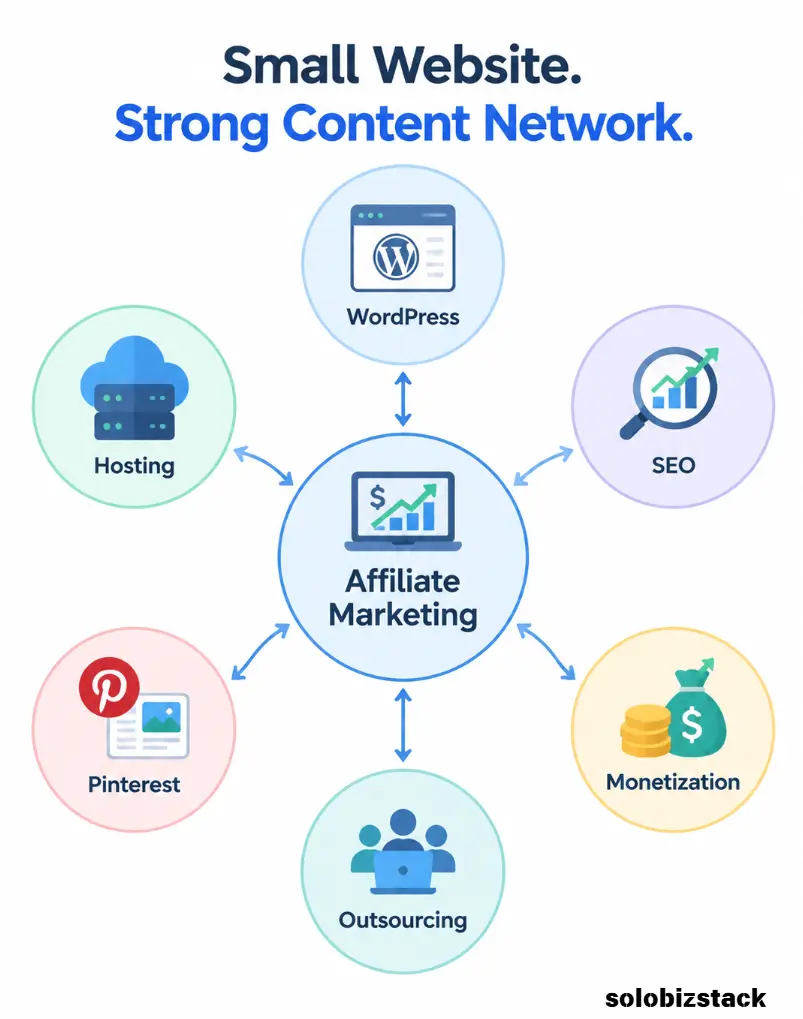
Affiliate Marketing
links to:
→ How to Make Money From a Blog as a Beginner
→ Best SEO Tools for Small Websites
→ Pinterest SEO for Beginners
→ How to Use Pinterest to Drive Traffic to Your Blog
→ Best Website Hosting for Beginners
→ How to Build a WordPress Website for Beginners
Now a visitor who discovers one article can continue exploring the site.
This also gives search engines clearer context about how your topics are related.
[Learn How to Make Money From a Blog →]
Step 13: Build Your Affiliate Site Around One Clear Audience
This is where many small websites become either focused or messy.
Suppose your target reader is:
A beginner trying to build and monetize an online business alone.
That one audience can connect:
Build
WordPress, hosting, themes, websites.
Create
Blog images, AI tools, content, Pinterest Pins.
Grow
SEO, Pinterest, traffic, keyword research.
Sell
Affiliate marketing, Fiverr, digital products, outsourcing.
Suddenly, your site has multiple categories without feeling random.
That is a much stronger structure than creating content about whatever affiliate program happens to offer a high commission that week.
Step 14: Use a Simple Affiliate Website Stack
You do not need a huge technology stack to start.
A practical setup could be:
WordPress
Your website and publishing platform.
Rank Math
For on-page SEO, schema, titles, descriptions, and optimization.
Pretty Links
For organizing and managing affiliate links where appropriate.
Google Search Console
For monitoring search visibility and queries.
Google Analytics
For understanding traffic and user behavior.
Canva
For blog graphics and Pinterest Pins.
That is already enough to build a real content-based affiliate site.
Add new tools only when they solve a problem you actually have.
[See the Best SEO Tools for Small Websites →]
Step 15: Create Your First Five Affiliate Articles
A small website does not need 100 affiliate articles to get started.
Begin with five strong pieces.
For example:
Article 1: Beginner Guide
How to Start Affiliate Marketing With a Small Website
Purpose: Explain the entire system.
Article 2: Commercial Guide
Best Website Hosting for Beginners
Purpose: Help readers choose hosting.
Article 3: Comparison
Hostinger vs SiteGround: Which Web Host Is Better for Beginners?
Purpose: Help readers make a final decision.
Article 4: Problem-Solving Content
How to Create Blog Images Without a Designer
Purpose: Solve a content creation problem and introduce relevant design tools.
Article 5: Traffic Content
Pinterest SEO for Beginners: How to Get More Traffic
Purpose: Help generate traffic and lead readers toward Pinterest-related tools.
This is already the beginning of an affiliate content ecosystem.
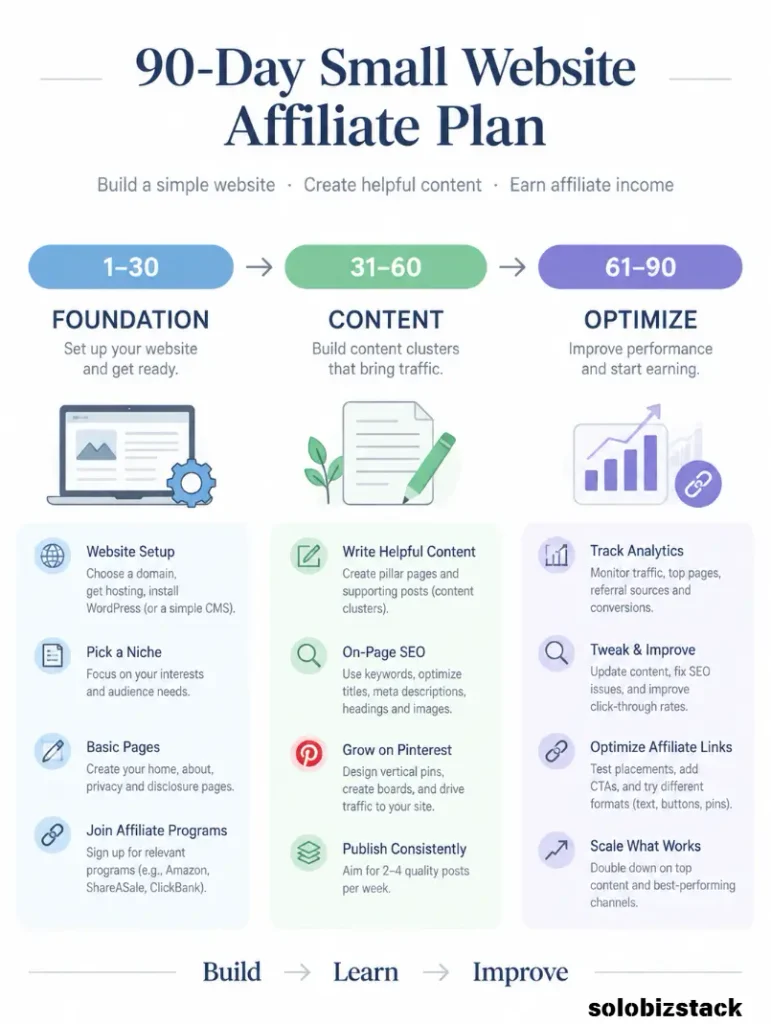
A Simple 90-Day Plan for a Small Affiliate Website
The easiest way to avoid overwhelm is to work in stages.
Days 1–30: Build the Foundation
Choose your audience.
Choose your core categories.
Build the essential pages.
Set up WordPress.
Install your basic SEO tools.
Create your affiliate disclosure.
Join only the programs that are genuinely relevant.
Publish your first useful articles.
The goal is not revenue yet.
The goal is building a credible foundation.
Days 31–60: Build Content Clusters
Create supporting articles around your main topics.
Add internal links.
Create Pinterest Pins where appropriate.
Improve your titles and meta descriptions.
Start watching your Search Console data.
Look for pages that receive impressions but few clicks.
Those pages may need stronger titles, better search intent alignment, or clearer content.
Days 61–90: Improve What Is Already Working
Now look for signals.
Which pages receive traffic?
Which articles generate affiliate clicks?
Which topics perform well on Pinterest?
Which pages keep readers exploring?
Then improve the winners.
Add better examples.
Improve comparison sections.
Strengthen internal links.
Add clearer CTAs.
Update outdated information.
Do not assume that publishing more articles is always better.
Sometimes improving ten existing pages is more useful than adding ten new ones.
[Follow the 90-Day Blog Monetization Plan →]
Mistakes to Avoid With a Small Affiliate Website
Mistake 1: Choosing Products Before Choosing the Audience
Starting with an affiliate program is backwards.
Start with people and problems.
Then find relevant products.
Mistake 2: Publishing Thin Affiliate Articles
A 500-word page that repeats a merchant’s product description is unlikely to give readers much reason to choose your page.
Add analysis, comparisons, examples, limitations, alternatives, and useful context.
Mistake 3: Promoting Everything
More affiliate links do not automatically create more revenue.
They can make your site harder to trust.
Keep your recommendations selective.
Mistake 4: Pretending You Personally Used Something
Do not write:
“I used this tool for six months and loved it.”
unless you actually did.
You can still research and explain a product without pretending to have personal experience.
Mistake 5: Making Income Promises
Avoid statements such as:
“This method will make you $1,000 per month.”
or:
“You can make passive income without doing anything.”
Affiliate income varies dramatically.
Your job is to explain the system, not promise an outcome.
Mistake 6: Ignoring Affiliate Program Rules
Every program can have different rules.
Check its current terms before using:
- paid advertising
- coupons
- email links
- social media promotion
- trademarked keywords
- direct linking
- incentive traffic
- certain countries or regions
A strategy that works for one program may be prohibited by another.
How to Know When Your Small Website Is Ready to Monetize
You do not have to wait for a specific traffic number.
Instead, look for signs that the site has a useful foundation.
You should have:
A clear audience.
A clear topic.
Several genuinely useful articles.
A logical internal-link structure.
A working disclosure.
Relevant affiliate products.
A way to measure traffic and clicks.
A few pages that attract search or social traffic.
At that point, monetization becomes much more natural.
You are not adding affiliate links to an empty website.
You are monetizing an existing information resource.
Frequently Asked Questions
Can I start affiliate marketing with a small website?
Yes. A small website can start affiliate marketing as long as it provides useful content, has a clear audience, and recommends products that genuinely fit that audience.
How much traffic do I need before starting affiliate marketing?
There is no universal traffic threshold. A smaller audience with strong buying intent can be more valuable than a large audience that has little interest in the products you promote.
How many affiliate programs should a small website join?
Start with a small number of relevant programs. Five well-matched programs can be more useful than dozens of unrelated ones.
What should I promote on a small affiliate website?
Promote products and services that solve problems your audience already has. For a solopreneur-focused site, examples can include hosting, WordPress tools, SEO software, design tools, Pinterest tools, AI tools, and outsourcing services.
Do I need to personally use every affiliate product?
No, but you should never imply that you have personal experience when you do not. Be clear about what you personally tested and what you learned from research or official product information.
Can I use Pinterest to promote a small affiliate website?
Pinterest can be used as part of a traffic strategy, but you should follow Pinterest’s current rules as well as the terms of each affiliate program you use. Pinterest has also announced policy updates scheduled to take effect November 12, 2026, so check the current policies before publishing or scaling a Pinterest-based affiliate strategy.
Should I use affiliate links in every article?
No. Use them when they genuinely help the reader. Some articles should focus entirely on education, while others can naturally include comparisons and product recommendations.
Final Thoughts
You do not need a giant website to start affiliate marketing.
You need a website that makes sense.
Choose one audience.
Solve their problems.
Create useful content.
Connect related articles.
Recommend a small number of relevant products.
Then measure what happens and improve the pages that show promise.
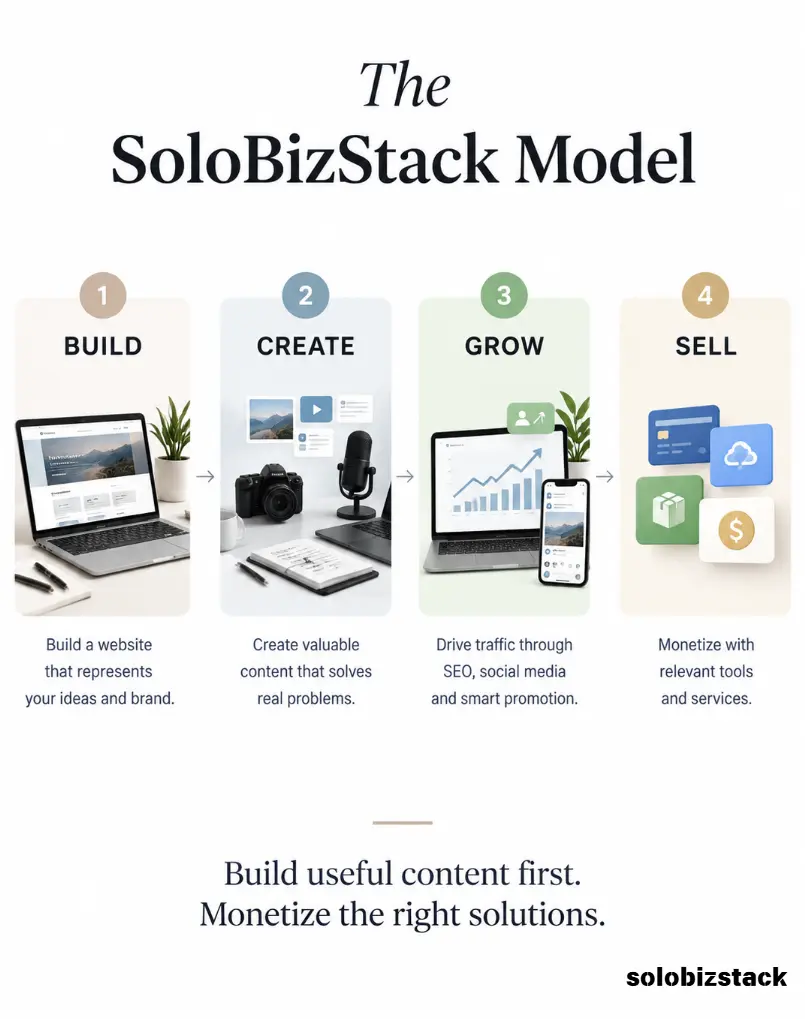
For SoloBizStack, this means building a clear path from:
Build → Create → Grow → Sell
A reader can start by learning how to build a website, move into content creation, learn how to attract traffic, and eventually discover tools and services that help them monetize their business.
That is the real opportunity of a small affiliate website.
You are not trying to compete with giant media companies on day one.
You are trying to become genuinely useful to a specific group of people.
Do that consistently, and affiliate marketing becomes a natural part of the website instead of the entire purpose of it.