
Hostinger vs SiteGround: Which Web Host Is Better for Beginners?
Choosing a web host isn’t exactly the most exciting part of building a website.
You probably want to get your WordPress site online, publish your content, and move on to the things that actually matter.
But choosing the wrong hosting plan can make things harder than they need to be.
So, Hostinger vs SiteGround — which one should you choose?
The short answer is: it depends on what you need.
Hostinger is particularly appealing if you’re starting a website and want a relatively simple setup with a lower introductory price. SiteGround is worth considering if you put more emphasis on managed WordPress features, support, and the overall hosting experience.
In this guide, we’ll compare Hostinger and SiteGround across pricing, ease of use, WordPress features, performance, support, and overall value.
Quick Answer: Hostinger vs SiteGround
If you just want the short version:
Choose Hostinger if:
- You’re building your first website
- You want to keep your initial hosting cost lower
- You prefer a straightforward setup
- You’re running a blog, affiliate site, portfolio, or small business website
- You want room for multiple websites on eligible plans
Consider SiteGround if:
- You want a more WordPress-focused hosting environment
- Managed WordPress features are important to you
- You value support and website management tools
- You’re willing to pay more after the introductory period
Neither option is automatically better for everyone.
For a beginner building a small website, Hostinger is the option I’d look at first.
For someone who cares more about managed WordPress features and doesn’t mind higher renewal pricing, SiteGround deserves a closer look.
Hostinger vs SiteGround at a Glance
Here’s the quick comparison before we get into the details.
| Feature | Hostinger | SiteGround |
|---|---|---|
| Best for | Beginners and small websites | WordPress-focused users |
| WordPress | Yes | Yes |
| Free SSL | Yes | Yes |
| Free domain | Available with eligible plans | Available |
| Website migration | Available | Free website transfer |
| Backups | Plan dependent | Daily backups |
| CDN | Included on current plans | Included |
| Website builder | Yes | Yes |
| 24/7 support | Yes | Yes |
| Introductory pricing | Lower on current offers | Competitive promotional pricing |
| Renewal pricing | Higher after promotion | Significantly higher after promotion |
| Overall focus | Simplicity and value | Managed hosting experience |
*Prices and promotions can vary by region and change over time. Check the provider’s current pricing before purchasing.
Hostinger vs SiteGround Pricing
Let’s talk about pricing first, because this is where the difference becomes pretty noticeable.
And there’s one thing you should know before comparing hosting prices:
Don’t look only at the number advertised on the front page.
Hosting companies often show an introductory monthly rate based on a longer billing period. The renewal price can be considerably higher.
Hostinger Pricing
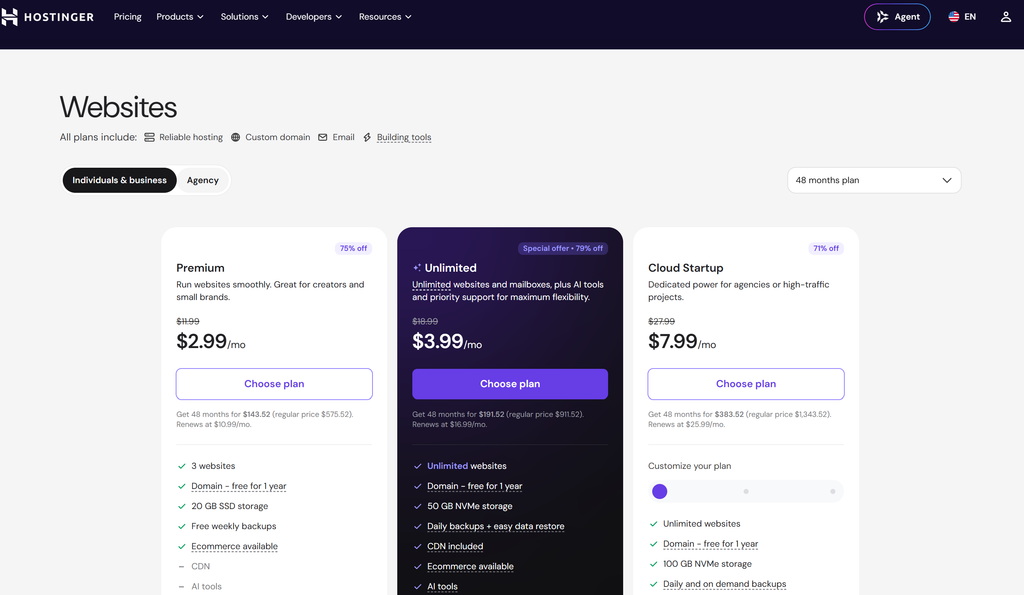
Hostinger’s current web hosting page lists its Premium plan at $2.99/month when purchased for 48 months, with a total upfront payment of $143.52. The listed renewal price is $10.99/month. The current Premium plan includes up to three websites, a free domain for one year, 20 GB SSD storage, weekly backups, CDN, and other features.
That’s a pretty attractive starting point if you’re launching your first website.
But there’s an important catch:
The $2.99/month price is promotional pricing.
You’re paying for the selected term upfront, and the renewal rate is higher. Hostinger also explains that renewal pricing can be checked in your account before renewal.
So don’t build your budget around the promotional price forever.
Hostinger pricing makes the most sense if:
- You’re comfortable paying for a longer initial term
- You’re starting a new website
- You want to keep initial costs manageable
- You may eventually run more than one website
SiteGround Pricing
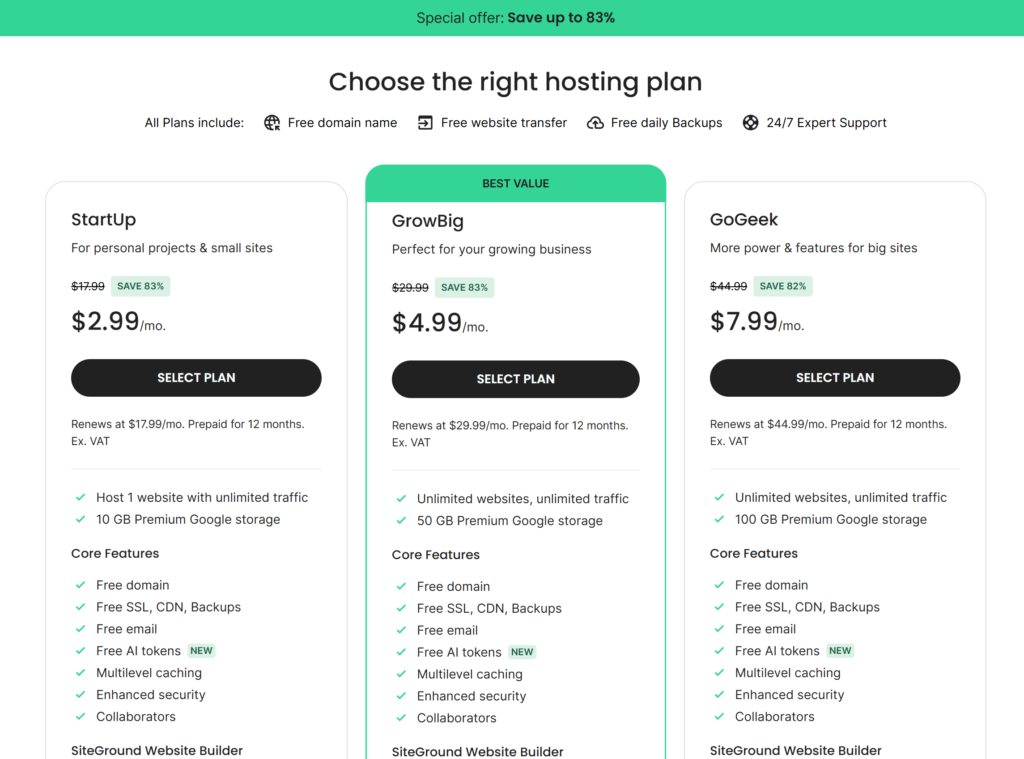
SiteGround’s current StartUp plan is listed at $2.99/month on its promotional offer, with renewal shown at $17.99/month. The plan is designed for one website and currently includes features such as free SSL, CDN, daily backups, free email, website transfer, and WordPress-related tools.
SiteGround’s GrowBig plan is currently shown at $4.99/month during the promotional period and renews at $29.99/month. It supports unlimited websites and adds features such as on-demand backups and staging.
Again, the important part isn’t just the promotional price.
Look at the renewal price and total cost over time.
Which Is Cheaper?
For many beginners, Hostinger is likely to be the more cost-conscious choice, particularly when looking at its current introductory offers and renewal pricing.
SiteGround can still be good value, but its renewal prices are noticeably higher on the current plans.
So if price is your biggest concern:
Hostinger gets the edge.
But price shouldn’t be your only consideration.
Hostinger vs SiteGround: Ease of Use
If this is your first website, ease of use matters more than having a huge list of advanced features.
You don’t want to spend your first weekend wondering why your website isn’t working.
Hostinger for Beginners
Hostinger puts a lot of emphasis on making website setup accessible to beginners.
Its current hosting offering supports WordPress, an AI website builder, templates, CDN, email, and other tools from the same hosting environment.
That makes it a convenient starting point if you don’t have much technical experience.
For someone building a simple:
- Blog
- Affiliate website
- Portfolio
- Small business website
- Personal website
Hostinger is fairly easy to understand.
Best for simplicity:
Hostinger
SiteGround for Beginners
SiteGround is also designed to be accessible to beginners.
Its current plans include a website builder, WordPress services, website migration, managed updates, backups, CDN, and other website management features.
The difference is that SiteGround tends to lean more heavily into managed hosting and WordPress-oriented functionality.
That’s useful if you want more than just basic hosting.
Best for managed WordPress features:
SiteGround

Hostinger vs SiteGround for WordPress
If you’re planning to use WordPress, both are viable options.
The question is really:
Which hosting environment fits the way you want to run your website?
Hostinger WordPress Features
Hostinger’s current plans support WordPress and include tools for website management, backups, CDN, and AI-assisted website creation.
For a beginner, that’s a pretty practical combination.
You can get your hosting, domain, WordPress site, email, and other basic website tools in one place.
SiteGround WordPress Features
SiteGround puts a stronger emphasis on managed WordPress.
Its current plans include managed WordPress updates, free site migration, WP-CLI and SSH, and an AI Agent for WordPress. Higher plans add features such as staging and on-demand backups.
That makes SiteGround interesting if you’re planning to get more serious about WordPress management.
Hostinger vs SiteGround: Performance
This is where you should be careful with online hosting comparisons.
You’ll see plenty of articles saying things like:
“Company A is always faster.”
That’s usually too simplistic.
Your website’s performance depends on much more than the hosting company.
Things like:
- Your hosting plan
- Website traffic
- WordPress plugins
- Images
- Theme
- Caching
- CDN
- Database size
- Website configuration
can all affect performance.
Both Hostinger and SiteGround currently include CDN and performance-related features in their hosting offerings. SiteGround also highlights multilevel caching on its current plans.
So rather than saying one is automatically “faster,” I’d look at the overall setup.
For a typical beginner website:
Either provider can be a reasonable choice.
Hostinger vs SiteGround: Customer Support
Support becomes important when something breaks.
And let’s be honest — eventually, something probably will.
Maybe WordPress gives you an error.
Maybe a plugin causes a problem.
Maybe your domain isn’t pointing where you expected.
That’s when good documentation and support can save you a lot of time.
Both Hostinger and SiteGround currently advertise 24/7 support.
SiteGround also highlights its expert support and WordPress-focused tools.
Hostinger emphasizes 24/7 support and beginner-friendly website setup.
My takeaway:
Hostinger: If keeping the overall setup simple and cost-conscious is more important, Hostinger may be the more natural starting point.
SiteGround: worth considering if support and managed WordPress features are higher on your priority list.
Hostinger Pros and Cons
Hostinger Pros
- Beginner-friendly setup
- Competitive introductory pricing
- Supports WordPress
- Useful website-building tools
- CDN included on current plans
- Multiple websites available on eligible plans
- AI website-building tools available
- 30-day money-back guarantee currently advertised
Hostinger Cons
- Promotional pricing is not the same as renewal pricing
- Some features depend on the hosting plan
- Longer billing periods mean paying more upfront
- You need to check renewal costs before committing
SiteGround Pros and Cons
SiteGround Pros
- Strong WordPress focus
- Free website transfer
- Daily backups on current plans
- CDN and SSL included
- Managed WordPress updates
- 24/7 expert support
- Staging available on higher plans
- Useful website management features
SiteGround Cons
- Renewal pricing is considerably higher than introductory pricing
- StartUp is limited to one website
- Some advanced features require higher plans
- May not be the most cost-effective option for a very small beginner website
Who Should Choose Hostinger?
Hostinger is worth considering if you’re starting from scratch and want to keep things relatively simple.
It could be a good fit if you’re:
- Building your first WordPress website
- Starting an affiliate blog
- Creating a personal blog
- Launching a small business website
- Building a portfolio
- Testing an online business idea
- Planning to manage several small websites
One thing I particularly like about the current offering is that the Premium plan supports up to three websites, which gives beginners some room to experiment without immediately needing a separate hosting account for every project.
If you’re new to websites and want a straightforward place to start, I’d put Hostinger near the top of your list.
Who Should Choose SiteGround?
SiteGround makes more sense if you’re willing to spend more for a more managed WordPress-focused experience.
It could be a better fit if you:
- Want managed WordPress features
- Value website migration tools
- Want daily backups
- Need staging on an eligible plan
- Expect your website to become more sophisticated
- Prefer a hosting provider with a strong WordPress focus
SiteGround’s current plans include several WordPress management features, with higher tiers adding staging and additional functionality.
Hostinger vs SiteGround: Which One Should You Choose?
Here’s the easiest way to think about it.
| If You Care Most About… | Consider |
|---|---|
| Starting your first website | Hostinger |
| Lower initial hosting cost | Hostinger |
| Simple setup | Hostinger |
| Running several small websites | Hostinger |
| Managed WordPress features | SiteGround |
| Daily backups | SiteGround |
| Website migration | SiteGround |
| Staging on higher plans | SiteGround |
| WordPress-focused management | SiteGround |
My recommendation
If I were choosing hosting for a new beginner website today, I’d start by looking at Hostinger.
Not because it’s automatically the “best hosting company.”
It’s because the current combination of introductory pricing, beginner-focused tools, WordPress support, and multiple-site options makes it a practical starting point for a small website.
I’d look more closely at SiteGround if I knew from the beginning that managed WordPress features, backups, migration, and support were worth paying more for.
And whichever one you choose, don’t forget to check the renewal price before you buy.
That’s the part many hosting comparison articles conveniently leave out.
Hostinger vs SiteGround: Frequently Asked Questions
Is Hostinger better than SiteGround for beginners?
For many beginners, Hostinger can be the simpler and more budget-friendly starting point. SiteGround is also beginner-friendly, but its higher renewal pricing may make it less attractive if keeping long-term hosting costs low is important to you.
Is Hostinger cheaper than SiteGround?
Hostinger currently has a lower renewal price on the plans compared here. However, hosting prices and promotions change, so compare the full billing term and renewal price before purchasing.
Can I use WordPress with Hostinger and SiteGround?
Yes. Both providers support WordPress hosting.
Which is better for an affiliate website?
Both can work well for an affiliate website. For a new, relatively small affiliate site, Hostinger may be attractive because of its lower current entry and renewal pricing. SiteGround may be worth considering if you want more managed WordPress functionality.
Can I move my website from Hostinger to SiteGround later?
Yes. Websites can generally be migrated between hosting providers. The process may involve moving your website files, database, DNS settings, email, and other configurations.
Does Hostinger include a free domain?
Hostinger’s current eligible Premium plan includes a free domain for one year. Check the specific domain extension and plan terms before purchasing.
Does SiteGround include backups?
Yes. SiteGround currently lists free daily backups across its hosting plans.
Does Hostinger have a money-back guarantee?
Hostinger currently advertises a 30-day money-back guarantee for its hosting offering.
Final Verdict
So, Hostinger vs SiteGround — which one wins?
There’s no universal winner.
Choose Hostinger if you want:
Simple + affordable + beginner-friendly
It’s a particularly sensible starting point for a new blog, affiliate website, portfolio, or small online business.
Choose SiteGround if you want:
Managed WordPress features + support + more advanced hosting functionality
You’re likely to pay more, especially after the introductory period, but you may find the additional features worthwhile.
For most beginners starting a new website:
I’d start with Hostinger.
Just make sure you compare the full upfront cost and renewal price, rather than making your decision based on the promotional monthly price alone. Hostinger and SiteGround both currently display promotional pricing that differs substantially from their listed renewal rates.
Ready to Start Your Website?
If you’re building your first website, take a look at the current plans and choose the hosting option that fits your budget and long-term needs.
→ Check Hostinger Plans
→ Check SiteGround Plans
Affiliate Disclosure
Some links on this page may be affiliate links. If you purchase a product or service through one of these links, we may earn a commission at no additional cost to you. Our recommendations are based on usefulness, features, value, and suitability for different users.